The ELCA Church Council meets today at the Higgins Road headquarters in Chicago to consider a document entitled Trustworthy Servants as a replacement for a prior document entitled Vision and Expectations. The proposed document comes to the Council following recent action by the Conference of Bishops. To be sure, the current document purports to be LGBTQ-friendly and apologizes for the harm done by the earlier document, but the failure of the Conference of Bishops to consult with, much less to include, voices from the LGBTQ community regarding the draft document has resulted in a firestorm across broad swaths of the ELCA. I have friends and colleagues who will be present today to oppose the document, and my sense is that the document in its current form is doomed, and the process will be re-opened with the red-faced bishops belatedly welcoming LGBTQ voices to the conversation.
My own take is that this is a classic example of privilege blind to its own malign paternalism. I’m sure the bishops genuinely believed their intentions to be pure and their actions to be beneficial toward those most affected by the policy. That bishops failed to recognize their flawed process is especially head-scratching in light of the sordid history in which the predecessor document became church policy.
The Evangelical Lutheran Church in America (ELCA) came into existence in 1988 as a result of the merger of three Lutheran bodies, including the two largest Lutheran denominations at that time. In the fall of 1987, just prior to the effective date of the merger, four gay Lutheran seminarians from California “came out” following their attendance at a national “Coming Out Day” in Washington D.C. Three of the seminarians were seniors and one a junior. Without any fuss just weeks before the merger became official, the three seniors were routinely certified for call and ordination as part of a larger slate of candidates approved by seminary faculty and the “Professional Preparation Commission” of the local synod.
The press picked up the story of the pending ordinations, and the new headquarters of the ELCA in Chicago was barely operational when the s___ hit the fan in February 1988 with “an avalanche of letters and phone calls to parish pastors, synodical bishops and our church-wide offices here in Chicago.” A month later, at the March 1988 meeting of the Conference of Bishops, a statement was crafted announcing the policy that “Persons of homosexual orientation who seek to be ordained or who are already ordained will be expected to refrain from homosexual practice.” In the new denomination with new rules and practices, no one realized at that time that the Conference of Bishops had neither adjudicatory nor legislative authority to establish such a policy for the church. Only the voting members at Church Wide Assemblies or the elected Church Council have the authority to enact church policy. Nevertheless, the bishop’s policy was followed, and the three candidates for ordination were grilled. “Are you presently celibate, and do you promise to remain so?” When the candidates declined to make such a promise, their ordination approvals were withdrawn.
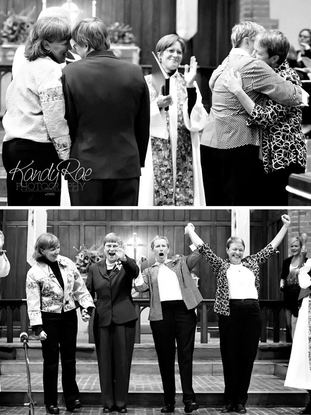
A number of Bay Area congregations responded by forming a coalition called Lutheran Lesbian and Gay Ministry (LLGM)*, “committed to the Gospel, to lesbian/gay ordained pastoral leadership, and to progressive ministry, with, by and for the lesbian/gay community.” In 1989, the coalition devised a bold plan to call and ordain Jeff Johnson, one of the rejected seminarians, to a San Francisco congregation, and—for good measure—to call a lesbian couple (Ruth Frost and Phyllis Zillhart) to another congregation. The watchword for the pending ordinations was extra ordinem (extraordinary), and the ordinations were scheduled for early 1990. At the November 1989 Church Council meeting, the chair of the Legal and Constitutional Review Committee was invited to submit a “hurry-up” proposal because the prior Bishop’s statement was non-binding and “because some synods have immediate need [for] such guidelines, in order to deal with issues already pending,” an obvious reference to the scheduled San Francisco extraordinary ordinations.
The council adopted the proposal which lumped all sorts of sexual behavior together: “adultery, promiscuity, the sexual abuse of another, the misuse of counseling relationships for sexual favors, and homosexual genital activity constitutes conduct that is incompatible with the character of the ministerial office.” Nevertheless, the Bay Area ordinations proceeded with great fanfare, resulting in controversial ecclesiastical trials and ultimately the banishment of the two offending congregations from the ELCA, but that’s a story for another day. Our present focus is on the genesis of the document known as Vision and Expectations. It was at the October 1990 meeting, following the extraordinary ordinations and tumultuous church trials earlier that year, that the document was discussed. The document included the language, “Ordained and commissioned ministers who are homosexual in their self-understanding are expected to abstain from homosexual sexual relationships.”
While researching for my book, Queer Clergy, a History of Gay and Lesbian Ministry in American Protestantism, I reviewed the minutes of that October Council meeting at the ELCA archives in Chicago. The minutes do not record an actual vote on the document (was it formally adopted?), but they do include comments from a robust discussion.
A [member] inquired in what sense is the document to be considered policy. [Another member responded], “It is not a juridical document that is to be used in an official sort of way. It is rather a document that describes the behavior of clergy. It is not a prescriptive document.” [Another member] termed the document “a teaching resource.”
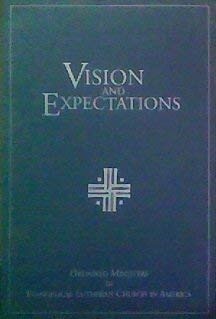 Non-prescriptive, indeed. Despite the questionable de jure status, the document became de facto policy. The document was soon published in booklet form and seminarians were required to submit to oral and written interviews in which they were asked, “Do you intend to live in accord with … Vision and Expectations?”
At the time, a seminarian complained, which became the lament for an entire generation, “I could lie about who I am. I could deny who I am. I could say openly who I am. The first two options meant loss of my self. The third option meant loss of my calling.”
At the 2009 Church Wide Assembly, the policy was reversed (another story for another day), and in the ten years since, countless LGBTQ persons have joined the official roster of ELCA ordained clergy, which brings us to the current hubbub over the recent action of the Conference of Bishops pertaining to the Trustworthy Servants document, which is intended to replace Vision and Expectations.
I smile inwardly at the irony that reflects the change in American and Lutheran culture. In 1988, a firestorm of protest resulted in restrictive, anti-gay, exclusionary policies through a flawed deliberative process. Three decades later, the outcry resounds in the opposite direction and will likely effect a more inclusive process and result.
This is merely a “tip of the iceberg” treatment of the history. If you’re interested in digging deeper, contact me to obtain a copy of the book I referenced above, which former Presiding Bishop, Herb Chilstrom, calls “the definitive text on the subject.”
*LLGM is the predecessor to Extraordinary Lutheran Ministries (ELM).