Forcing the Spring, the recent best-seller by New York Times reporter Jo Becker, purports to chronicle the back story to the sweeping success of the marriage equality movement across the nation, but critics complain that the book gives too much credit to Becker’s sources and too little to the significant contributions of others, especially earlier pilgrims in the long journey toward marriage equality. In response, author Becker acknowledges that “The book is about one chapter in a larger narrative, and that narrative includes so many people who worked so hard on this issue when the going was far tougher than it is today.”
Indeed.
Let us consider the role of progressive religion. Against well-entrenched religious opposition to all things gay, progressive religious leaders were early voices “crying in the wilderness,” and decades of advocacy within religious spheres have largely prepared the good soil for recent marriage equality policy breakthroughs.
In the sixties, the issue was not marriage equality but criminalization and police harassment of homosexuals. Of course, the Stonewall riots in Greenwich Village in the summer of 1969 exploded as a spontaneous backlash to a police raid on a gay bar, and Stonewall has become the iconic moment that marks the birth of the gay liberation movement.
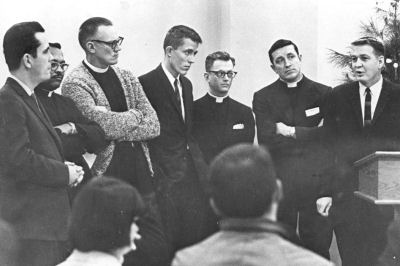
Clergy press conference following police raid of 1964 New Year’s ball
However, nearly five years before Stonewall, the San Francisco based Council on Religion and Homosexuality (CRH) sponsored a New Year’s Eve ball in 1964 that was raided by police, and the clergy who appeared at a press conference the next day to denounce the police behavior focused the eyes of the nation on abusive police practices and policies. One commentator suggested the clergy provided the “cloak of the cloth,” a powerful and visible sign of religious support for the LGBT community. In 1965, the prestigious Christian Century Magazine suggested, “the law … should not penalize private immoralities which cannot be proved contrary to the common good.” The first LGBT policy statements of the ecumenical Protestant denominations (Methodists, Lutherans, Presbyterians, Episcopalians, United Church of Christ) in the late sixties and seventies called for the decriminalization of homosexuality and homosexual behavior.

The 1970 Holy Union of Father Robert Mary Clement and John Darcy Noble, Rev. Troy Perry officiating
By the 1990’s, still long before marriage equality was on the legal horizon, many clergy conferred a blessing on the relationships of their gay or lesbian parishioners, variously referred to as “covenant ceremonies,” “rites of blessing,” commitment services,” “holy unions,” and other terms. In fact, the terminology “holy union” dates to 1970 when independent (non-Roman) Catholic priest, Father Robert Mary Clement, who had marched in his clerical robes in the first Gay Pride parade in New York City, was joined with his life partner in a religious ceremony, and the officiant was Rev. Troy Perry, who had started the Metropolitan Community Churches (MCC), a predominantly gay denomination, months before Stonewall. In 1993, Perry and the MCC organized a Washington D.C. event they dubbed simply “The Wedding,” and Perry claimed “At least 2,600 same-sex couples, complete with tuxedos and wedding gowns, made a public commitment in a mass ritual.”
Meanwhile, the ecumenical Protestant churches wrestled with policies regarding blessing gay and lesbian couples.
- In 1993, the Lutheran Conference of Bishops stated that although the church did not recognize an official ceremony of blessing, the bishops acknowledged the prerogative of pastors and congregations in ministry with gay and lesbian persons to “explore the best ways to provide pastoral care,” and that was widely interpreted to allow clergy discretion to preside at rites of blessing.
- After Methodist Pastor Jimmy Creech was defrocked and Pastor Greg Dell suspended just before the turn of the century for presiding at covenant ceremonies, nearly one hundred West coast Methodist clergy jointly officiated in the covenant service of a lesbian couple. Though Methodist policy remained unchanged, the horde of media representatives and bank of television cameras at the February 2000 press conference announcing that no ecclesiastical charges would be filed against the “Sacramento 68” demonstrated that the same-sex marriage issue had captured the attention of the world.
- When Massachusetts became the first state to recognize marriage equality in 2003, by judicial fiat, the local Episcopal bishop initially encouraged his priests to refrain from conducting marriage ceremonies, but the priests widely ignored their bishop, and within a few years, the bishop himself presided at a lesbian wedding–of two of his priests, no less!
- On July 4, 2005, the UCC General Synod formally endorsed marriage equality with an overwhelming vote for a resolution that “affirms equal marriage rights for couples regardless of gender and declares that the government should not interfere with couples regardless of gender who choose to marry and share fully in the rights, responsibilities and commitment of legally recognized marriage.”
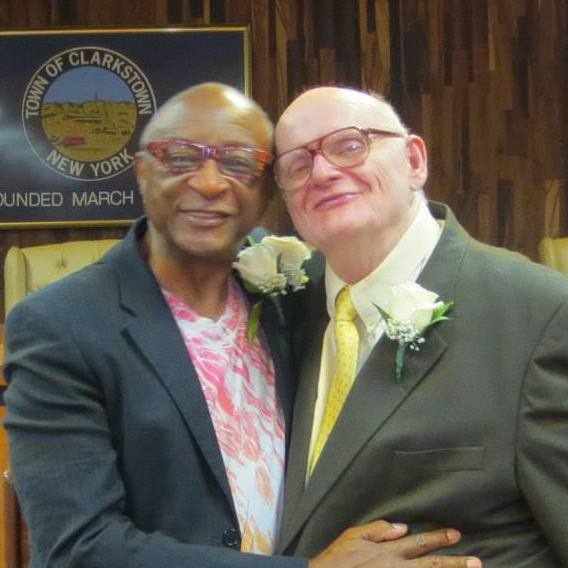
- In the last decade, the Presbyterian journey to full LGBT inclusion was marked by ecclesiastical trials wrestling with rites of blessing, and the Presbyterian courts made it clear that rites of blessing were permitted as long as it was not a legal marriage ceremony. Yet, when the Presbyterian “Supreme Court” instructed her local presbytery to censure Rev. Dr. Jane Spahr, who has long been the “poster lesbian” of the Presbyterian Church, for officiating at legal marriages of gay and lesbian couples, the presbytery instead issued a resolution of support for Rev. Dr. Spahr’s ministry. All Presbyterian eyes are on Detroit this week where issues of marriage equality are front and center of the General Assembly.
In the last dozen years, as marriage equality has gained momentum in the civil sphere, so too has full inclusion of LGBT persons moved forward in the religious sphere, at least within the ecumenical denominations. By removing the gates to the pulpit through revisions to ministry policies–that is, by ordaining partnered gays and lesbians–the UCC (as early as the 1970s), the Episcopalians, the Lutherans, and the Presbyterians have all recently affirmed that the relationships of gay and lesbian partners are to be recognized, supported, and celebrated. Without attempting too fine a point regarding a chicken or egg analysis, when the moral authority of the church swings toward inclusion, public opinion will be affected.
Finally, and especially germane to the recent sweeping success of marriage equality adjudication and legislation across jurisdictions, the role of progressive clergy in statewide pro-equality movements cannot be understated. The example of Minnesota is illustrative. In 2012, a restrictive constitutional amendment was defeated by the electorate, and marriage equality was enacted during the next legislative session in 2013. Minnesotans United was the LGBT advocacy group that successfully worked on both measures, and their strategy “refused to cede the religious ground.” Though the local Roman Catholic Archbishop was an outspoken opponent of marriage equality, ecumenical Protestant and Jewish clergy served in highly visible leadership roles. Minnesota clergy issued joint communiques, provided legislative testimony, appeared at rallies and press conferences, and a priest, a minister, and a rabbi came into a bar together in a humorous TV ad. The clergy collar was omnipresent in LGBT advocacy efforts.
Marriage is a legal contract, defined and sanctioned by the civil law but with significant religious overtones, and the voices of opposition to LGBT rights have long used religion to bolster their arguments. Because of the religious underpinnings to LGBT issues, legal and societal progress would have been slowed or thwarted without the counter-influence of activists and allies, within the church, who offered the “cloak of the cloth” from the earliest days, who provided the example of holy unions to bless and solemnize gay and lesbian relationships, and who “refused to cede the religious ground.”
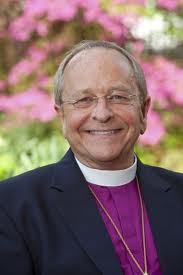
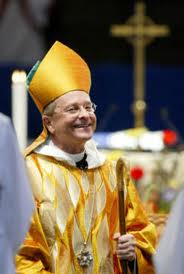
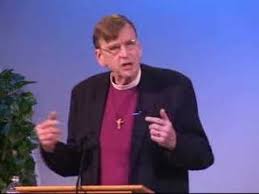
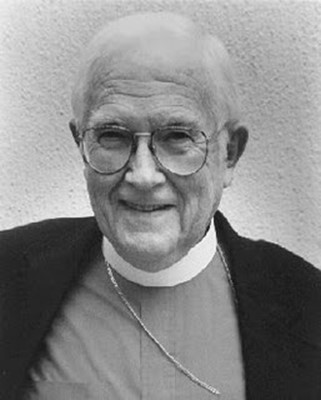 Rt. Rev. Walter Righter had ably served as bishop of the Iowa Episcopal Diocese for sixteen years, and in 1988 at age 65 he had earned voluntary retirement. Little did the combat veteran of the WWII Battle of the Bulge know that his most significant contribution in conflict would come a decade later.