Author Archives: Obie Holmen

ELCA Lutherans and social media

twitter_logo_header Through the Twitter use of #hashtags, it is possible to follow all Tweets that address issues of interest to an ELCA person.  The hashtag is simply #ELCA.  As I write this, a quick scan of a Twitter #ELCA search reveals first page results about Presiding Bishop Hanson speaking to the gathering of Anglicans in England, several links to a Lutheran Magazine article about hospitality (“The meaning of hospitality: It’s more than food and a comfy bed. It is about standing side-by-side with someone you may not agree with, may not understand, or don’t even like.”), and miscellaneous links to articles regarding ecumenism, migration, calendar of events, etc.

Some of the same articles appear with a search of the hashtag #Lutheran, but with a broader scope of Lutheranism to include LCMS items, Lutheran World Relief (LWF), and a few links to Lutheran theological articles.

Lovin the Lutherans Facebook promotes participation in interest groups, and a couple that I belong to include my local synod and a rapidly expanding new group called “Lovin the Lutheran Church” with a motto of “Proud to be Lutherans in the Evangelical Lutheran Church in America.”  Facebook is not the place for an in depth discussion of an issue, but it can provide a quick link to news articles or blog posts.  Facebook is for short comments and equally brief responses.  The most recent comment as I post this is “A majority, but not 2/3, of Good Shepherd, Monroeville, PA, members vote to leave the ELCA. Congregation will remain, but is deeply divided,” and the comment also provides a link to a newspaper article.  In less than 24 hours, this comment has received 23 replies.

Calendar of events: Lutherans and progressive Catholic

Lutherans Concerned North America Let Justice Roll Assembly 2010

“Let justice roll down like waters, and righteousness like an ever-flowing stream” —Amos 5:24


let justice roll You are invited to participate in Let Justice Roll, the biennial assembly of Lutherans Concerned / North America and Reconciling in Christ conference. Let Justice Roll will be held at Augsburg College in Minneapolis, MN July 7–11, 2010.

Let Justice Roll is more than a conference. It is an opportunity to explore and live out the work of reconciliation that we are called to do. Justice requires reconciliation, and reconciliation takes effort. Throughout our time together, we will work on justice issues from the intersection of oppressions (racism, sexism, ablism, etc.) and through the lens of full participation of people of all sexual orientations and gender identities in the life of the Lutheran Church.

Call to Action Shatter the Stained Glass Ceiling Tour

This link will take you to the calendar of events sponsored by Call to Action that promote female ordination within the Roman Catholic Church.  Call to Action is a major progressive Catholic organization.  The following is a short list of the soon to occur events, but click through for the full calendar and a map.

Santa Fe, NM
February 4, 7pm
St. Bede’s Episcopal Church
1601 St. Francis Drive

Albuquerque, NM
February 5, 7pm
Albuquerque Mennonite Church
1300 Girard Blvd. NE

Sarasota, FL, 2pm
February 20
St. Andrew’s UCC Church
6908 Beneva Rd. S.

Dallas, TX
February 27

Chicago, IL
March 2nd

WordAlone Network Annual Convention

April 18 & 19 at Calvary Lutheran, Golden Valley, Minnesota.  Rescheduled to avoid a conflict with the LCMC convention a week later in Omaha.

Exegetical Theology and The Lutheran Confessions

I missed this one which occurred on Jan 19th, but I mention this Lutheran Church Missouri Synod conference because of one noteworthy speaker on the agenda:  Mark Chavez, a director of Lutheran CORE and recently vice president of the WordAlone Network.  It is fascinating that Chavez is warmly received as a speaker at an LCMS theological conference.  I doubt whether any CORE or WordAlone speakers will be invited to a United Methodist, Presbyterian, UCC, Episcopal, Moravian, or Reformed Church in America theological conference.  These denominations are the full communion partners of the ELCA and are considerably more “middle of the road” than the conservative LCMS, and Chavez’ participation at the LCMS conference is a clear indication of the veer to the right that CORE chooses to travel.

Second Fargo congregation restores ELCA Lutheran funding

Thanks to reader, Pastor Ray from Recovery Church of Fargo, for the link to a news story about the 2nd Fargo ELCA congregation to change course and reinstate funding to the ELCA.  The story in Fargo’s Forum said that last September Pontoppidan Lutheran withheld funding by placing the ELCA pledged funds in escrow.  Pontoppidan members voted this week to release the escrowed funds and also reinstate ongoing financial support of the ELCA.

Earlier posts here and here discussed similar funding restoration by Hope Lutheran, the largest Fargo ELCA congregation, and also by St. Luke’s of Cottage Grove, Minnesota.

Judaism and gays

There are three main “movements”, “denominations”, or “branches” of Judaism in North America called Orthodox, Reform, and Conservative.  From Canada comes a report of same gender relationships now receiving blessings in a Conservative synagogue in Winnipeg.

Winnipeg’s largest synagogue is moving toward full inclusion for gay and lesbian Jews by offering to bless their same-sex unions. Since Jan. 1, 2010, rabbis at Shaarey Zedek synagogue have been willing to bless Jewish same-sex couples in commitment ceremonies.

Rabbi Alan Green says the Winnipeg synagogue is thought to be the first Conservative movement synagogue in Canada to offer blessings to same-sex unions. In December 2006, the movement’s New York-based Committee on Jewish Law and Standards approved extending blessings to same-sex unions, a move that carries a great deal of weight among Conservative congregations, but is not binding, says Green.

Although this is a new step for Conservative Judaism, considered more middle of the road, Winnipeg’s lone Reform synagogue has offered the ritual for a decade, says Rabbi Karen Soria. “We are still the only synagogue in Winnipeg where a gay or lesbian couple could be married Jewishly,” says Soria, who divides her time between Winnipeg and Ottawa, where her female partner is a chaplain in the Canadian military. “Reform Judaism has taken very seriously the need to open doors and be welcoming. Historically, Reform Judaism has been very aware of and studies the seismic changes in Jewish life over the centuries.” The Reform movement is considered one of the more liberal Jewish groups.

Rabbi Greenberg Meanwhile, an Orthodox Rabbi, Steven Greenberg, has been out for over a decade, and he has been pushing back against the Orthodox policy that prohibits homosexual behavior.

Rabbi Steven Greenberg is not shy about proclaiming who he is, though it raises eyebrows.

He is, he says, the world’s first openly gay Orthodox rabbi.

And since he came out in 1999, Greenberg has traveled the world, speaking at Jewish organizations, community groups, forums. His latest stop is the Seattle area, where he’s conducting several workshops through Saturday.

His aim: To get congregations to be more welcoming and understanding of gays and lesbians — which sometimes means just helping them learn how to even bring the topic up.

Ultimately, he hopes the work he’s doing can, over time, lead to changes in people’s hearts, and to corresponding changes in Jewish theology and law.

“By addressing the realities of human life, Jewish law does move,” Greenberg said. “It just moves slowly.”

The Religious Action Center of Reform Judaism (RAC), headed by Rabbi David Saperstein, is a well-known advocacy group that:

has been the hub of Jewish social justice and legislative activity in the nation’s capital for more than 40 years. The RAC educates and mobilizes the American Jewish community on legislative and social concerns, advocating on issues from economic justice to civil rights to religious liberty to Israel.

The RAC’s work is mandated by the Union for Reform Judaism, whose 900+ congregations across North America include 1.5 million Reform Jews, and the Central Conference of American Rabbis (CCAR), whose membership includes more than 1,800 Reform rabbis.

The RAC has long promoted LGBT rights.

A follow up to continuing ELCA Lutheran stories

Yesterday, I blogged about Hope Lutheran of Fargo.  At Hope’s congregational meeting, the membership passed a resolution overturning the decision of the Pastor and the Council to withhold funding of the ELCA. 

Turns out the same thing happened at St. Luke’s of Cottage Grove, Minnesota, according to a news report from the South Washington County Bulletin.  In a comment to yesterday’s post, John Petty suggested, “yet another case where the pastor took the lead in opposing CWA [Church Wide Assembly] and fomenting dissension within his or her congregation.”  John’s comment applies to the St Luke’s situation as well.  According to the news report, the church council stopped funding the ELCA synod and national offices following a rant from the pastor:

In late August, when the Evangelical Lutheran Church in America met for its churchwide assembly in Minneapolis, St. Luke pastor Tim Housholder gave an impassioned speech to the group about his opposition to allowing gay clergy.

“I stand here finally on God’s holy word which calls homosexuality sin and calls all of those living out this lifestyle to the cross, not to receive tolerant love, but transforming and life-changing love,” Housholder said at the conference.

The news report indicated that the membership voted last Sunday at the annual meeting to partially restore congregational benevolence to the synod upon recommendation of the church council.

A second story that requires a follow up comes from the Northeastern Iowa synod of the ELCA.  Just before Thanksgiving, this synod become a hot topic in the Lutheran blogosphere because the synod council passed a couple of resolutions that rejected the pro-LGBT decisions of the CWA.  At the time, the Lutheran CORE website trumpeted the actions of the synod council as a harbinger of an anti-CWA groundswell.  Turns out CORE was just a tad premature inasmuch as the Synod Council has now reversed course and rescinded its own resolutions.

Blogger friend Susan Hogan at Pretty Good Lutherans hosted a lively debate at that time, and she has reposted the discussion.  The rescission was reported in a letter from the synod council vice president Karen Armstrong to the synod on Feb 1. 

In her letter Armstrong wrote, “Our council received many responses to these (synod council) actions. There were some who misinterpreted our actions as being defiant of the churchwide decision, and even suggested that we had voted as a synod to leave the ELCA.  Nothing could be further from the truth.”

She wrote that others were concerned that the synod council made decisions “that placed the council as a higher authority than the local congregation.  There was also a concern that the synod council had placed itself as a higher authority than the churchwide assembly.”

One Lutheran congregation votes to send withheld funds to ELCA

The trickle of congregations departing the ELCA and the individuals who have chosen to worship elsewhere have been painful for both sides.  For those of us staying with the ELCA, we sadly bid those folks farewell with our best wishes.  We recognize that they have differing religious world views that may make the LCMS, or evangelical congregations, or the loose association of congregations known as LCMC, or even the yet to be created and defined Lutheran CORE denomination more compatible with their beliefs.  These departures are sad but understandable.

Less defensible is the decision of many individuals and congregations who choose to stay in the ELCA but to withhold funds.  Lutheran CORE bears responsibility for this manipulative and vindictive financial boycott that frankly is counterproductive to their effort to win friends and influence people.  I previously reported on the crack in Lutheran CORE’s resolve regarding this issue in the words of CORE spokesperson, Pastor Erma Wolf, who was quoted by a local newspaper after speaking to a congregation early in January:

“I’m not withholding my church offerings and I would not encourage a congregation to do that,” CORE’s Wolf said. “As long as we’re in the ELCA, we need to be financial stewards of the church.”

Following the Haiti disaster, Wolf followed up with a post on the Lutheran CORE blog urging contributions to ELCA disaster relief.  Since the CORE blog does not publish reader comments, it is uncertain how her position resonates with CORE leadership or followers.

All this is background to a story from Hope Lutheran Church of Fargo, North Dakota, the largest ELCA congregation in the largest city in the state.  It is merely an anecdote, one story that stands out from many others, and certainly should not be read as a trend; yet, it is a fascinating tale. 

Hope Lutheran of FargoHope is one of those that remains in the ELCA but chose to withhold funds.  According to the story posted in Fargo’s Inforum, this decision emanated from pastoral leadership and congregational Council action.

In October, Hope Senior Pastor Chuck Olmstead wrote on the Hope Web site that the congregation’s “leadership has suspended all financial support to the ELCA.”

This top-down decision for the congregation didn’t sit well with certain members, including George Koeck, and he did something about it.  He proposed a counter-resolution at the annual congregational meeting, and his resolution passed.  The resolution authorized a gift of $10,000 to the ELCA synod.

George Koeck, a Hope Lutheran member, said he proposed the amendment Thursday because he believes “that the fundamental mission of Hope, to encourage all people to know the love of Christ, is far more important than differences of belief we may have on human sexuality.”

Eastern North Dakota Bishop Bill Rindy said he was “really glad” about the church’s decision on funding the national offices.  “Some really good ministries will be funded because of that,” he said.

Does this story signal a shift in attitude among those congregations uncomfortable with the actions of the 2009 Church Wide assembly?

As to whether this is a sign that backlash against decisions at the Churchwide Assembly are dying down, Rindy said, “I don’t know if it’s dying down as much as it is that most congregations are realizing that they have members all along the spectrum on this particular topic.”

And that, it seems to me, is the essence of bound conscience, a recognition that well meaning ELCA Lutherans can hold differing views without name-calling (“unchurched and heretical”), financial manipulation, and schismatic rabble rousing.  Thank you Mr. Koeck and Hope Lutheran for your example for the rest of us.  Thank you also, Pastor Wolf, for swimming against the Lutheran CORE current.

ELCA Lutheran Haiti disaster response

On January 12th, two and 1/2 weeks ago, the earthquake disaster hit Haiti.  Immediately, on the 13th, the ELCA announced an immediate commitment of $250,000 toward disaster relief and also promised another $500,000 in anticipation of receipt of sufficient donations from ELCA members and member churches.

On January 15th, the ELCA announced it would keep a phone bank open to receive contributions and also announced a “strong and generous response from members” that could soon raise the ELCA contribution to $1 million. 

On the 19th, the ELCA announced it had received at least $1.2 million or more when all the checks were counted.

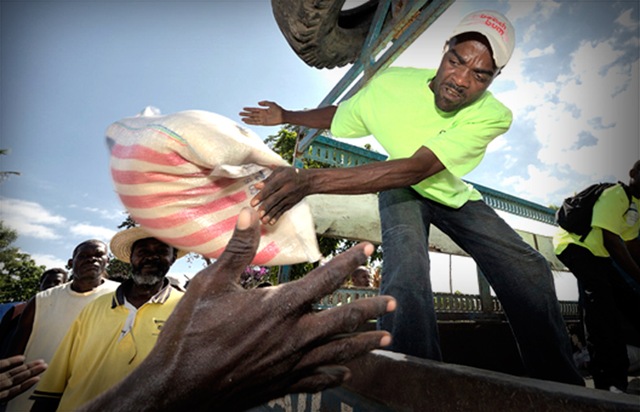
Haiti relief On the 20th, the first convoy of Lutheran World Federation (LWF) relief supplies arrived in Port au Prince.

Also on the 20th, Lutheran CORE spokesperson Erma Wolf broke with CORE’s financial boycott of the ELCA, stating, “I am going to make a suggestion, request, perhaps plea is the best word for it, now,” she wrote.  “Send an offering to the ELCA Vision for Mission Fund.”

On the 22nd, the total gifted to the ELCA reached $1.6 million.

On the 29th came the announcement that the state of Florida had enlisted the services of Lutheran Disaster Response to assist with processing Haitians with US passports through Florida airports into the US.

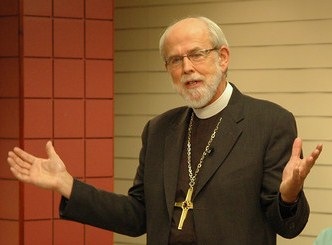
Bishop Hanson forum Also on the 29th, presiding bishop Mark Hanson issued a letter to ELCA constituencies announcing the ELCA gifts had reached $2.5 million, summarizing the ELCA efforts to date, and encouraging further member contributions.  His letter is printed in full below:

Dear sisters and brothers in Christ,

“If one member suffers, all suffer together with it;
if one member is honored, all rejoice together with it.”
–1 Corinthians 12:26

Almost two weeks have passed since the devastating earthquake in Haiti. The outpouring of gifts from members of the Evangelical Lutheran Church in America (ELCA) to ELCA Disaster Response has enabled a swift response on behalf of this church. 

Thank you for your generous financial support which now totals more than $2.5 million. Many gifts are still being counted. Our community-based partners are already providing:

  • Two water purification systems to bring clean water to 25,000 people.
  • Emergency food and medical supplies to thousands.
  • Blankets and tents to shelter 10,000 people who are homeless.

Funding, distributed through three partners, will increase as giving continues.

  • $300,000 has been sent to The Lutheran World Federation (LWF), a key responder and member of Action by Churches Together (ACT). The funds support LWF efforts to provide shelter to people left homeless by the quake. 
  • $150,000 has been sent to Lutheran World Relief (LWR), Baltimore, for material aid.
  • $150,000 will be sent to Church World Service (CWS) for construction of temporary water systems and distribution of water purification materials. 

In addition, $25,000 has been sent to Lutheran Services of Florida for initial support to refugees and Haitian Americans entering or returning to the United States.

We are pleased that Louis Dorvillier, director for International Development and Disaster Response in the ELCA Global Mission program unit, is part of a delegation to his country of origin with LWF and ACT.

Your generosity makes this life-saving work possible. As we celebrate this outpouring of gifts and prayers, we also know that we have a long road to travel together. There is so much more to be done. This church is committed to walking with our brothers and sisters in Haiti for years to come; your continued support is needed to provide ongoing care.

I encourage you to visit the ELCA Disaster Response (http://www.elca.org/disaster) Web site for updated information, worship resources, bulletin inserts and details on how to offer financial support. General mission-support dollars and gifts to ELCA Vision for Mission make it possible for 100 percent of your gifts designated for Haiti Earthquake Relief to be used entirely for this response effort.

To give today, go online (www.elca.org/haitiearthquake) or call 800-638-3522.

In God’s grace,

The Rev. Mark S. Hanson
Presiding Bishop
Evangelical Lutheran Church in America

Is Lutheran CORE fundamentalist?

One of the blogs I follow on my RSS reader is Otagosh.  I think that Gavin, the author, is in New Zealand, but since there is no “about” page, I’m not sure.  Gavin, if you read this, can you provide more info?  In any case, Gavin offered his perspective on the question, What is the Bible and how do we use it? 

[It’s not fiction, like a novel], but by the same token it’s hardly factual writing either, whether New Testament Gospels or Old Testament “history.” If you want to take the Bible seriously you have to meet it on its terms [as an ancient text].

The problem then isn’t with the Bible. The problem is with post-Enlightenment people trying to shoehorn ancient texts into contemporary categories. The Bible isn’t meant to be read in the same way as an instruction manual, recipe book, or newspaper report. Nor is it like some kind of weird jigsaw puzzle where you have to string together bleeding chunks of text from all over with the aid of Cruden’s concordance.

Fundamentalism provides the most egregious “all or nothing” example: the Bible is either 100% reliable in everything, or it isn’t “true.” An army of skeptics happily rise up to accept that thesis, and conclude – quite rightly if you follow the logic – that as there are errors, the Bible is useless.

Lutheran Pastor and blogger Doug Kings of Chicago is critical of Christendom’s (and especially our own ELCA) wishy-washy failure to confront the often simplistic, naive, and literal assumptions of the folks in the pews.

[L]et the Bible be what it is: the collected thoughts of a particular ancient people, containing their prejudices and ignorance but also some genuinely profound insight into living with God and with one another in our paradoxical world of beauty and pain, purpose and confusion.

Modern scholarship has actually discovered a great deal about the Bible but much of it is ignored because it doesn’t tell us what we want to hear. Modern biblical study’s totally unsurprising conclusion is that the Bible is theology, through and through. Thus, it isn’t history, biology, geology, astronomy, economics, political science, psychology or any of the other contemporary subjects which so fascinate us and about which we have so many questions. For answers to them, we must look elsewhere.

Professor emeritus Walter Brueggemann is one of the most esteemed and influential Bible scholars around, and I previously offered a blog post on his Christian Century article in which he posited that Scripture is “Remembering an Imagined Past.”  Brueggemann has authored the leading work of Old Testament scholarship of the past generation entitled Theology of the Old Testament: testimony, dispute, advocacy.  In his preface, he offers the following explanation of his methodology.

I have focused on the metaphor and imagery of courtroom trial in order to regard the theological substance of the Old Testament as a series of claims asserted for Yahweh, the God of Israel.  All of these claims share a general commonality but also evidence considerable variation, competition, and conflict … where truth is at issue and at risk, testimony is given by many witnesses, witnesses are vigorously cross-examined, and out of such disputatious adjudication comes a verdict, an affirmed rendering of reality and an accepted version of truth.

Biblical scholarship is serious business, not amenable to simplistic sound bites or proof texts.  As someone who has been drawn to this discipline for the past generation and as an ELCA Lutheran active as an LGBT advocate within my denomination, I take particular offense at the Lutheran CORE putdown that the ELCA has become unbiblical.  From Lutheran CORE talking points comes the following tripe:

“The ELCA is the one that has departed from the teaching of the Bible”.  “Lutheran CORE intends to remain with the clear teaching of Scripture”.  “Lutheran CORE would like to help those in the ELCA who continue to uphold the authority of Scripture to find a way to continue to maintain basic Christian teaching as revealed in the Bible.”

Following a recent meeting of the big shots of CORE, WordAlone, and Lutheran Congregations in Mission for Christ (LCMS), a press release was issued containing a revealing paragraph about CORE’s attitude toward the Bible and scriptural interpretation:

Confessional Lutherans accept the Bible as the sole, divine source and norm for all Christian teaching and endorse the 1580 Book of Concord—the statement of Lutheran doctrines—as being accurate interpretations of Holy Scripture. The Bible repeatedly condemns sexual relationships outside of a marriage between one man and one woman.

There are learned persons, Biblical scholars and professors, who stand behind CORE; for that reason, this quasi-fundamentalist statement is stunning.  Let us parse this paragraph a bit.

Sole: only; exclusive; standing alone.   No room for reason.  No room for conscience.  No room for experience.   Simple.  Just consult the ancient book of rules to answer all modern questions.  Even Luther would have disagreed with such simplicity.

Unless I am convinced by the testimony of the Holy Scriptures or by evident reason … Thus I cannot and will not recant, because acting against one’s conscience [informed by Scripture] is neither safe nor sound. God help me. Amen.

Divine: not human; perfect; beyond question.  I guess Brueggemann was wrong—there is no “variation, competition, and conflict” present in this perfect expression of God’s will, nor CORE’s perfect interpretation of it.  To refer to the Bible as “divine” smacks of rank Bibliolatry, but in reality it is a political maneuver meant to limit debate or dissent from a fundamentalist view.  Much as the ancient Hebrews could not bear to look upon the face of God, one probes the divine Word at one’s peril.  Dare not ask questions of the divine text.

1580 Book of Concord: I confess that I am not well-read in the Lutheran writings of the sixteenth century.  What I find astounding in the statement, given the scholars that are part of CORE’s hierarchy, is CORE’s static interpretation of scripture according to a document dated 1580, which establishes the pre-modern worldview of the reformers as preferable to the  insights of the past four centuries.

The Bible repeatedly condemns sexual relationships outside of a marriage between one man and one woman:  If the fundamentalists say this often enough, will it come true?  Proving the falsity of this statement is like shooting fish in a barrel.  One example, that of Father Abraham, shall suffice, but we could go on and on.

So, after Abram had lived ten years in the land of Canaan, Sarai, Abram’s wife, took Hagar the Egyptian, her slave-girl, and gave her to her husband Abram as a wife.  He went in to Hagar, and she conceived.  Genesis 16:3-4a

Episcopal Priest Susan Russell recently offered a blog post in which she quoted an article from Professor Rosemary R. Reuther, entitled A Biblical View of Marriage: One Man and Several Women.

The point here is not to mandate either patriarchal polygamy or New Testament celibacy, but to dispute the notion that God in the Bible mandated one view of marriage, from the beginning and for all time. Rather marriage is a human arrangement which has varied over time, according to human (mostly male) views of their needs for sex, relationship, kinship alliances and progeny. In the West in the last few centuries the need to cement social alliances through marriage and to create (male) heirs has decreased, and the primary purpose of marriage has come to be seen as love, preferably between two people in a permanent relationship.

There are smart and educated persons in CORE, and they ought to know better than to spout such unscholarly and fossilized views of the canon coupled with accusations that the rest of us are unbiblical.  It is not that we don’t take the Bible seriously, as CORE alleges, it is that we take it too seriously to avoid challenging questions informed by reason, experience, and the lessons of scholarship, both traditional and modern.

Lutherans in ecumenical news

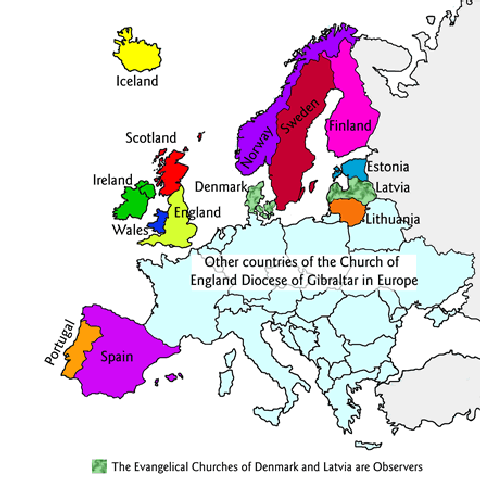
Episcopal Life online reports that the Evangelical Lutheran Church of Denmark has joined the Porvoo Communion

This is the name given to a report issued at the conclusion of theological conversations by official representatives of four Anglican Churches and eight Nordic and Baltic Churches in 1989-1992. The Porvoo Common Statement included the text of the Porvoo Declaration, which the participants commended for acceptance to their Churches.

They were the Churches of England and Ireland, the Church in Wales and the Episcopal Church of Scotland, together with the Churches of Denmark, Norway and Sweden, and the Evangelical-Lutheran Churches of Estonia, Finland, Iceland, Latvia and Lithuania. Acceptance by the signatory churches means that for the first time the Anglican Churches in Britain and Ireland have now moved into visible communion with other national Churches in Europe.

Map of Porvoo participantsPreviously, the Denmark church had merely been an observer and not a signatory due to differences over the ordination of female bishops.  (The Danish Lutherans favored female bishops).  According to the Danes, Anglican bishops have “changed their positions considerably” on such issues, and there are no longer any doctrinal obstacles to membership.

Meanwhile, the Evangelical Lutheran Church in Canada (ELCIC) announces that their “Eastern Synod will host the North American region’s preparatory meeting for the July 2010 Eleventh Assembly of the Lutheran World Federation (LWF).”   

The Lutheran World Federation (LWF) is a global communion of Christian churches in the Lutheran tradition. Founded in 1947 in Lund, Sweden, the LWF now has 140 member churches in 79 countries all over the world representing over 68.9 million Christians.

The Canadian report indicates that there are three North American Lutheran denominations that belong to the Lutheran World Federation: the ELCIC, the ELCA, and the Estonian Evangelical Lutheran Church Abroad.  The Lutheran Church Missouri Synod (LCMS) and the Wisconsin Synod (WELS), the second and third largest Lutheran denominations in the US after the ELCA, do not belong to LWF.  The LWF has been front and center of Haiti disaster relief.  ELCA president Mark Hanson currently holds the presidency of the LWF, which has its international headquarters in Geneva.

Today, the ELCA and the Moravian Church will celebrate ten years of full communion partnership at Augsburg Lutheran Church, Winston-Salem, N.C.

Leaders and members of the denominations will be attending the worship service.  The Rev. Mark S. Hanson, ELCA presiding bishop, will preside and the Rt. Rev. Dr. D. Wayne Burkette, president, Provincial Elders’ Conference, Moravian Church North America, Southern Province, will be preaching.

The Moravian Church is one of six full communion partners of the ELCA (United Methodist, Episcopal, Presbyterian, UCC, and Reformed Church of America).

The ELCA takes seriously its call to act ecumenically for the sake of the world and not for itself alone. Unity does not mean that two churches merge; rather, in reaching consensus churches also respect difference. In this way, full communion is when two churches develop a relationship based on a common confessing of the Christian faith and a mutual recognition of baptism and sharing of the Lord’s Supper.  These denominations likewise jointly worship, may exchange clergy, and also share a commitment to evangelism, witness and service in the world.

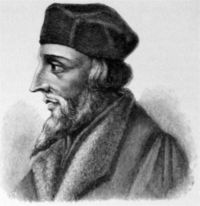
Jan Hus The Moravian church has its origins in 15th century Bohemia and Moravia (now part of the Czech Republic).  They trace their heritage to reformer Jan Hus, who predated Luther and who was burned at the stake for his heresy.  Hus and his followers planted the seeds of reformation which came to fruition under Luther, Calvin, and others a century later.  The Moravians arrived in the US in 1741.  Their website offers much more of their proud history.

Are American evangelicals complicit in the Uganda anti-gay movement?

Much attention has been focused on the Ugandan parliamentary bill mandating Draconian treatment of gays, up to execution, that has been shelved for the moment.  Undoubtedly, the international outcry has been effective.  The relationship between several American evangelical groups and the Ugandan anti-gay movement has also come to light, raising serious questions about the influence and extremism of these American gay bashers in the name of their evangelical Christianity.

Rick Warren, pastor of Saddleback mega-church in the US and the author of the popular The Purpose Driven Life, is perhaps the most visible of the evangelicals who had cavorted with the Ugandan leadership prior to the drafting of the hate-filled legislation.  Religion Dispatches blog has reported extensively on Warren and Uganda:

Yet last year, according to a press release from Warren’s public relations firm, he launched a “purpose-driven living” campaign in Uganda, organized by a former member of Parliament. While there — his fourth trip to the country — he met with the First Lady of Uganda, Janet Museveni. Warren’s statement today that he’s never met the president of Uganda or any members of parliament, then, seems hair-splitting. The press release, after all, did say, “This is the second East African country to invite Dr. Warren to bring the well- known Purpose Driven Life and Church leadership training to churches, businesses and government on a national scale.” At the time, Warren said, “my challenge to business and government leaders is to use their influence for the glory of God and partner with local churches in solving community problems.”

There is no evidence that Warren directly promoted the idea of the anti-gay legislation; yet, it is clear that his original foray into Uganda to instill his “Purpose Driven” plan was at the request of homophobe Anglican Archbishop, the Most Rev. Henry Luke Orombi.  According to a news release at the time appearing on Christian Post, it was Orombi who

recalled initially wanting to invite Warren to Uganda after seeing the Purpose Driven Living program implemented in Rwanda.

Uganda is the second east African country to invite Warren to bring the Purpose Driven Life and Church leadership training program to the country on a national scale. The first east African country to adopt the program nationwide was Rwanda in 2005.

It turns out that Orombi and first lady Janet Museveni, two of Warren’s principal contacts, have been among the most influential gay bashers in Uganda. 

After a month of waffling and suggesting it wasn’t his business to influence foreign nations internal policies, Warren finally bowed to pressure and issued a statement condemning the legislation, but his statement was also laden with self-serving denials:

There’s no doubt he has a strong relationship with government, business, and religious leaders in Uganda, according to his own statements. So it would seem logical for people at least to think he would have some sway to denounce the proposed law as a brutal violation of human rights and of Christian values. Instead of addressing the reasons why he waited to speak, though, Warren instead seeks to dispel “untruths” about his relationships with leaders there, and alleged misinterpretations of some of his statements. But that doesn’t tell us much about his relationships there, just which leaders and statements from which he’s now trying to distance himself. It would be more revealing to understand just what “purpose-driven living” is, how he has imparted that teaching to Ugandan leaders, and how they make use of it.

Exodus International is a well-known organization that promotes reparative therapy.  Reparative therapy is a discredited theory and practice of transforming gays to straight.  In August, 2009, the American Psychological Association issued a hard hitting condemnation of reparative therapy and its adherents.

The American Psychological Association concluded Wednesday that there is little evidence that efforts to change a person’s sexual orientation from gay or lesbian to heterosexual are effective.  The report looks at 87 studies conducted between 1960 and 2007.  In addition, the 138-page report — covering 87 peer-reviewed studies — said that such efforts may cause harm.

Of course, Exodus won’t allow the facts to inform their opinions, and they continue to inflict their “cure” on troubled gays who already doubt their human worth.
As an organization, Exodus was not directly involved in the rise of official Ugandan homophobia, but one of their board members was an early anti-gay spokesman in that country.  At a March, 2009 anti-gay conference in Kampala, Exodus Board member Don Schmierer was one of three presenters (Nazi revisionist Scott Lively was another).

Family Life Network has organized a training seminar to equip Ugandans with information and skills to fight what it calls spiraling promotion of homosexuality in the country.

[T]he seminar from March 5th to 7th will provide insight on the causes and treatment of homosexuality; provide practical tips on how to prevent homosexuality behavior in youth; expose the homosexual agenda … is intended for parents, guardians, teachers, government officials, policy makers, members of parliament, religious leaders, counselors and activists who need in-depth knowledge on the subject of homosexuality.

A blog called Box Turtle Bulletin has been on top of the Exodus-Uganda connection, with dozens of blog posts listed chronologically here.  A few pertinent items include the announcement of the anti-gay seminar on the floor of the Ugandan legislature, Exodus’ initial “applauding” of Schmierer’s participation, the Ugandan parliamentary foray into the anti-gay movement six weeks after the seminar, and finally the Nov 16th Exodus lukewarm rejection of the legislation only after the international outcry.

Written as it is by an organization which does not affirm the dignity and worth of LGBT people to live their lives responsibly in freedom and self-determination, there is certainly much in this letter that merits criticism. Furthermore, the letter makes no recommendations except to “consider the influence this law will have” on the work of those who believe that the only valid option for LGBT people is to self-deny their own existence. The “influence” this law will have on LGBT people themselves, well that’s apparently inconsequential and not worthy of discussion.

One final note regarding Exodus that will be of interest to regular followers of this blog.  Exodus International has a mutually supportive relationship with Lutheran CORE, the dissident ELCA group that resisted the pro-LGBT actions of the 2009 ELCA churchwide assembly and which continues as an ELCA irritant and schismatic movement.  At the ELCA church wide assembly, Lutheran CORE maintained a visible presence and a headquarters / hospitality room.  On Thursday evening of the assembly, they promoted a presentation by a representative of Outpost, an affiliate of Exodus International.  From the CORE newsletter of August 17th:

Thursday night will feature a presentation by Nate Oyloe, Youth and College Age Director for Outpost Ministries. “Outpost was formed to meet the needs of men and women who have made a decision to break away from the gay life,” its website
explains. Outpost is an affiliate ministry of Exodus International.

Oyloe, in turn, subsequently reported on his presentation in a post on the Exodus website:

Within the denomination is a group called The CORE – Coalition for Reform – that is committed to the upholding of God’s Word and the biblical understanding that homosexual behavior is sinful all the time, every time. The week before the convention Outpost was asked by The CORE to have a presence there. Outpost staff talked with delegates and shared their stories of transformation with individuals throughout the week. I was asked to speak to their group and share my personal testimony the night before the second vote passed. 

I also have private correspondence from an ELCA member in Florida whose pastor seeks to lead the congregation into CORE.  The pastor invited a CORE spokesperson, a Rebecca Heber, whose presentation to the congregation boasted of the CORE relationship with Exodus.

If we are known by the company we keep, then Lutheran CORE has some “splanin” to do about its affiliation with Exodus, its debunked reparative therapy theories, and its connection to the horrific anti-gay movement in Uganda. 

The International Transformation Network is the third evangelical organization that merits scrutiny for its Ugandan influence.  From their website:

The International Transformation Network (ITN) is a strategic alliance of Christians from the marketplace and the pulpit who are building prototypes for city and nation transformation that bring the presence and the power of God to meet the felt needs and the systemic challenges of our communities and countries.

As a result of a clear focus on five pivotal paradigms for transformation and the principles of prayer evangelism, real transformation is taking place in cities and nations around the world – in businesses, on campuses, in the halls of government, and within congregations.

Another web page lauds the program’s “prayer evangelism and marketplace redemption strategies to reach cities and transform nations for Christ.”  ITN promotes a full-blown and unapologetic prosperity theology, but with a governmental, theocratic twist–a three way partnership between government, business, and Christianity.

According to the Uganda State House website, in March, 2007 the Ugandan President and First Lady, Janet Museveni, (the same mentioned above as contact for Rick Warren) hosted a state dinner for the representatives of ITN.  A year later , in March 2008, the website reports the Museveni’s hosted ITN CEO Ed Silvoso, and Silvoso’s own website trumpets ITN’s relationship with “Mama Janet” and her role as a friendly First Lady in Uganda, “a nation completely ripe for transformation”.

These theocratic ideals, tinged with a prosperity gospel, are scary enough, but what about the the relationship of ITN and the anti-gay movement of Uganda?  The 18th ITN international conference of October, 2008 held in Argentina is revealing.  The speakers included exorcist Cindy Jacobs who offered a chilling, rabble-rousing, rant about “pornography’”, “homosexuals”, “bisexuals”, and “perversion” to a spell-bound, swaying audience.  Another speaker, a representative of ITN/Uganda praised “Mama Janet” for being “God’s key” to open not just Uganda but the whole African continent.  It also turns out that the daughter of “Mama Janet” is a pastor of a Ugandan church affiliated with the ITN, and it was one of her parishioners, a member of Parliament, who drafted the infamous anti-gay legislation. 

And then we come full circle back to the ELCA, back to Minnesota, back to Northfield, for it seems there are two Minnesota Lutheran congregations that have bought into the ITN prosperity gospel with its homophobic overtones. 

The first of these is Christ Lutheran Church of Otsego in the Elk River, Minnesota vicinity.  According to their website, they have a special congregational meeting called for January 31 to consider a resolution to secede from the ELCA.  The same web page has several links to anti-gay sermons of Pastor David Glesne of Redeemer Lutheran in Fridley, a Lutheran CORE and WordAlone Network congregation that has withdrawn from the ELCA. 

The second ITN Lutheran congregation is right here in Northfield; it is Rejoice Lutheran, and they claim inspiration from the Elk River example.

Rejoice! sees itself as a city leader in this prayer evangelism movement. We believe, through the power of community prayer, God is raising-up Christians in the city to bring others to the faith! Pastor Dan Clites says he is a pulpit minister, but our congregation is the marketplace ministers! Together, we are blurring the lines between the sacred and the secular!

Local speculation is that Rejoice will depart the ELCA, but a question remains about the significant mission financial support they previously received from the ELCA.  Will they keep it or give it back?  One wonders if Rejoice members know about the connection between ITN, their prosperity gospel mentor, and the anti-gay movement of Uganda; if so, are they ok with it?

Episcopal pastor, Elizabeth Keaton, has a lengthy post about ITN and their theocratic movement in her home city of Newark, and her post contains a video expose of ITN and their connections to the Uganda anti-gay movement.  Watch it!