Author Archives: Obie Holmen

ELCA Lutheran charity

Just a few end of the week notes about Lutheran charitable activities.

The latest number reported for the ELCA Haiti disaster relief is $1.2 million.

Earlier, I posted about Pastor Erma Wolf’s apparent break with the Lutheran CORE financial boycott of the ELCA.  Interestingly, there are no comments published on her blog post.  Since I attempted to offer a supportive comment which the blog did not publish, I wonder if she or someone else is trying to avoid a full-blown discussion of her statement in which she said, “I am going to make a suggestion, request, perhaps plea is the best word for it, now.  Send an offering to the ELCA Vision for Mission Fund.”   Of course, her statement is in stark contrast to the prior entreaties from Lutheran CORE to redirect funds away from the ELCA.

Here are some interesting charitable giving tidbits.  It would take 3 Frenchmen, or 7 Germans, or 14 Italians to equal the amount of charitable giving of 1 American.  The average US family donates approximately $2,000 annually.  Lower income folks donate a much higher percentage of their income to charity than high income folks. 

And here’s a trivia question for you:  what American charity raises the most revenue annually—an amount that would place the organization in the upper half of the Fortune 500 if it were a private business?

The answer surprised me—it is Lutheran Social Services (LSS) with annual revenues of $16 billion!  LSS is strongly supported by the ELCA and LCMS, but these eye-popping sums come from a much broader base than merely these two denominations, and I suspect most of the revenue is fee for services based rather than charitable contributions.

Billy Graham’s small college is “Left Behind”

Over thirty-five years ago, my wife and I lived in the northern suburbs of St. Paul, Minnesota while I attended law school at the University.  We toured the greater neighborhood aboard our ten-speed bicycles.  We sometimes pedaled through the arched gate to Northwestern College in the wooded hills of Roseville, which we learned was a small evangelical Christian college.  I have since learned that evangelist Billy Graham served as the president of the college from 1947-53.

But there’s trouble afoot.  Are the end times near?

An article appearing in the Minneapolis Star Tribune recounts the internecine fight between the administration and a group led by 1997 graduate Dallas Jenkins, the son of Jerry B. Jenkins the author of the “Left Behind” series of novels that promote the idea of end times rapture.  From the Left Behind Website:

Are you ready for the moment of truth?

  • Political crisis
  • Economic crisis
  • Worldwide epidemics
  • Environmental catastrophe
  • Mass disappearances
  • Military apocalypse
    And that’s just the beginning . . . of the end of the world. It’s happening now.

Dr Alan Cureton Seems Jenkins and his cronies are claiming the college is tilting away from its conservative roots, allowing an undesirable secular influence to creep in.  College President Alan Cureton is their foil.  From the Strib article:

Several former trustees said in a letter that they had seen the college’s culture changing and hoped it “might, by God’s gracious intervention, be spared the fate of so many other institutions that have witnessed the dying of the light. …”

Last January, the student government sent a letter expressing a vote of “no confidence” in Cureton and asking for his resignation or removal. The letter said that Cureton had committed “grievous sin, lies, slander, and unethical actions” –including lying about his reasons for demoting two faculty members and falsely accused another employee of viewing pornography.

In response, the board of trustees appointed a three person task force (including the president of the Evangelical Free Church of America) to investigate whether the charges of doctrinal drift were warranted.  They concluded they were not, but the sniping continues even though the website of the dissidents has been closed to the public by requiring password entry.  The college website openly acknowledges the controversy and attempts to put it in the past.

For regular readers of this blog, a familiar character made a cameo appearance in the Strib article.  Dr. Robert Benne, a member of the Lutheran CORE advisory council and author of several CORE articles that have been critiqued here and here, was consulted by the Strib apparently because he wrote a book about secular drift in religious colleges.

Prop 8 trial reveals abuses of reparative therapy

If you haven’t heard, a civil trial is underway in California contesting the constitutionality of Prop 8.  If you don’t know about Prop 8, it was a California referendum that passed by a slight majority in the 2008 election, and its effect was to preclude same gender marriage in California.

This is a much ballyhooed trial, not merely for its subject but also for its participants.  The two main attorneys that are pursuing the case are the same who opposed each other in Gore v Bush, the 2000 presidential election Florida recount case, who now join in common cause to have Prop 8 overturned as unconstitutional.   One of these is well known Republican and conservative attorney Theodore Olson, formerly of the Bush and Reagan administrations.

Attorney Olson explains his views in a Newsweek article, entitled The Conservative Case for Gay Marriage.

My involvement in this case has generated a certain degree of consternation among conservatives. How could a politically active, lifelong Republican, a veteran of the Ronald Reagan and George W. Bush administrations, challenge the “traditional” definition of marriage and press for an “activist” interpretation of the Constitution to create another “new” constitutional right?

My answer to this seeming conundrum rests on a lifetime of exposure to persons of different backgrounds, histories, viewpoints, and intrinsic characteristics, and on my rejection of what I see as superficially appealing but ultimately false perceptions about our Constitution and its protection of equality and fundamental rights.

Many of my fellow conservatives have an almost knee-jerk hostility toward gay marriage. This does not make sense, because same-sex unions promote the values conservatives prize. Marriage is one of the basic building blocks of our neighborhoods and our nation. At its best, it is a stable bond between two individuals who work to create a loving household and a social and economic partnership. We encourage couples to marry because the commitments they make to one another provide benefits not only to themselves but also to their families and communities. Marriage requires thinking beyond one’s own needs. It transforms two individuals into a union based on shared aspirations, and in doing so establishes a formal investment in the well-being of society. The fact that individuals who happen to be gay want to share in this vital social institution is evidence that conservative ideals enjoy widespread acceptance. Conservatives should celebrate this, rather than lament it.


Pastor Candice Chellew-Hodge is “the founder/editor of Whosoever: An Online Magazine for GLBT Christians and currently serves as associate pastor at Garden of Grace United Church of Christ in Columbia, S.C.”  A religious progressive, her blog post today carries the subtitle, “testimony shows the ugly side of religion”.  The subject is the discredited and abusive practice of reparative therapy—the misguided attempt to turn gay persons straight.  (See my prior blog post about reparative therapy here.)

The testimony, as reported by Pastor Chellew-Hodge, is compelling and heart wrenching.

I’m gay. I’m short and half Hispanic those things aren’t going to change.”

Those are the words Ryan Kendall uttered in a federal court in San Francisco on Wednesday as the trial over whether or not to overturn Proposition 8 that stripped gays and lesbians of their right to marry in California, got into its second week.

Kendall took the stand to recount his harsh treatment in an “ex-gay ministry.” His deeply religious parents forced him into so-called “reparative therapy” after finding a note that Kendall had written to himself confessing his sexual orientation at the age of 13. Kendall said his parents “flipped out, (they were) very upset, yelling. I don’t remember a lot of what they said, but it was pretty scary the level of their reaction. I remember my mother telling me I was going to burn in hell.”

Read the rest of the blog post and more testimony here.

A Wretched Man novel: 3rd Review is in

A Different Voice is a website devoted to progressive, Christian educators.  It reviews and recommends educational resources deemed suitable for progressive congregations.

There are many of us…progressive Christian education professionals, pastors, youth directors, parents, volunteers, lay ministers, conference staff people…who are committed to taking the Bible seriously but not literally…who believe justice and grace and compassion and love are at the core of what it means to be Christian…who practice spiritual disciplines and still love God with their minds as well…who know themselves to be on a meaningful and hope-filled journey of faith.

Tim Gossett of Different Voice is “a twenty-some year veteran of youth ministry and Christian education. He has masters degrees in Religious Education and Religious Communications from United Theological Seminary in Dayton, OH, is a certified Christian education director in the United Methodist Church, and is an author of a handful of books.”  Mr. Gossett posted a lengthy review of A Wretched Man that includes the following snippets:

If asked to recommend some good books about Paul for laypersons and church professionals, there are several candidates that would come to mind. Two, though, would receive my top recommendation. Borg and Crossan’s The First Paul would be tops on my list for its lucid and important description of the de-radicalization of Paul’s message by the early church. Next, I’d recommend a forthcoming novel, A Wretched Man: A Novel of Paul the Apostle by RW Holmen, a compelling exploration of the Jewish (Nazarenes) and Gentile (Pauline) movements in the first century. If you’ve ever struggled to understand Paul’s form of faith, Holmen’s work of historical fiction will help you to imagine your way into Paul’s life and times.

  1. Holmen definitely captures the “feel” of first-century Roman territories. I suspect most readers will feel as if every chapter will add to their knowledge about life in those difficult days, from the basics of daily life to the realities of trying to exist as an oppressed religious community. Holmen clearly loves that period of time, and he describes it beautifully and (I think) pretty accurately. His training as a historian is clearly evident. 
  2. The author brings to life the source of the conflict between the early Christian movements, namely that Jesus did not return as expected, and there were significant differences of opinion about what Jesus’ life and teachings meant for Torah-followers and Gentiles alike. We cannot hope to fully understand and appreciate the differences between the Jesus of the gospels and the Christ of faith in the Pauline letters without understanding these two very different “Christianities.”
  3. The novel helps contextualize the letters of Paul and clarify how their themes came about. Paul’s conversations and private thoughts eventually are woven into bits and pieces of the letters. Unlike some novels about Paul, this one contains very little of the actual letters themselves, though, focusing only on their key phrases and themes. Stories from the book of Acts are woven into the story arc, though many scenes originate in Holmen’s own imagined, fleshed-out version of the characters’ lives.
  4. It’s clear to me that Holmen (who has done post-graduate studies in theology and Christian history at a progressive Benedictine community in Minnesota) is well-versed in contemporary progressive scholarship about Paul. This is evidenced in subtle ways—I suspect many readers will not pick up on the progressive emphasis—and at times I wished Holmen had been able to more directly expand on some of the insights in the Borg/Crossan book I previously mentioned. Yet it’s definitely the rare religious novel that can be recommended to your parishioners without reservation. 
  5. Finally, the novel treats Paul, Barnabas, Peter, James, the various women Paul knew, Timothy, Titus, and many others as extraordinarily normal people. We witness their frustrations, their anger, their salty language and questionable behavior, and the mundane experiences of their everyday lives, not just their piety and faithful witness. In many ways, this is the greatest gift of A Wretched Man, because these characters can now leap off the page and into our imaginations. 

Read the full review here

Lutheran CORE financial boycott of ELCA revisited

Yesterday I came across a two week old newspaper article from Pipestone, Minnesota, a small city on the prairie of SW Minnesota.  The article reported on Tensions Within the Church Body, referring to the ELCA and the Lutheran CORE opposition.  It was a well written piece which addressed the status of a couple of local ELCA churches, and it also quoted extensively from Pastor Erma Wolf, one of the primary spokespersons for Lutheran CORE.  Although several of her comments merely parroted Lutheran CORE talking points, I was struck by this quote:

“I’m not withholding my church offerings and I would not encourage a congregation to do that,” CORE’s Wolf said. “As long as we’re in the ELCA, we need to be financial stewards of the church.”

This is striking, of course, because Wolf deviated from the Lutheran CORE party line, which has consistently encouraged ELCA congregations to withhold financial support of the ELCA.  On August 22, before the 2009 Church wide assembly had closed, the CORE newsletter stated,  “Lutheran CORE leaders are inviting faithful Lutheran congregations and individuals to direct funding away from the national church body because of the decisions made this week by the Churchwide Assembly.”  Furthermore, the Lutheran CORE website promotes a paper by Pastor Steven King which attempts to provide a justification for withholding financial support of the ELCA.

This morning, Pastor Wolf has taken her views a significant step further.  In an article posted on two blogs, Satis Est, her own personal blog and on Lutheran CORE’s blog, she proposes a radical departure from the Lutheran CORE financial boycott.  “I am going to make a suggestion, request, perhaps plea is the best word for it, now,” she writes.

“Send an offering to the ELCA Vision for Mission Fund,” Pastor Wolf pleads.

Haiti Of course, one could minimize Pastor Wolf’s radical departure from the Lutheran CORE position by pointing out the exceptional circumstances of the Haiti earthquake, which is the occasion of her appeal.  Yet, her own stated rationale goes further than Haiti (bearing in mind, her newspaper quote before Haiti, “As long as we’re in the ELCA, we need to be financial stewards of the church.”):

Why? Because the main reason the ELCA International Disaster Relief Fund can dedicate such a high percentage of the offerings it receives to those who are most in need is because the ELCA Churchwide budget covers the cost of offices, lights, office machines, and staffing expenses. That is part of the mission work of this denomination. The Disaster Relief folks don’t have to pay for that stuff, so their money can go to places like Haiti. (And the flood victims in Iowa, and the hurricane victims on the Gulf Coast, and the tornado victims in Oklahoma, and you name the places where the ELCA has been in the past 10 years.)

Kudos to Pastor Wolf. 

One can only hope that her good sense and compassion rubs off on her cronies at Lutheran CORE.  Perhaps she sees that the CORE financial boycott has been a classic “cut off the nose to spite the face” effort from the outset.  Perhaps she understands that the financial boycott affects those who need ELCA missions and ministries the most.  Perhaps she senses that the boycott serves only to depict Lutheran CORE as mean-spirited, vindictive, and manipulative.  Certainly, Wolf’s plea reflects an adult understanding of the positive benefits that flow from the denominational infrastructure of the ELCA, something which Lutheran CORE as a separate denomination can only aspire to years down the road.

Most importantly, let’s hope that we can mark this as a breakthrough in the acrimonious relationship that has developed between CORE and the ELCA.  Again, kudos to Pastor Wolf.

Gun sights for Jesus

Howard Friedman Howard Friedman is Professor of Law Emeritus at Toledo University, and he publishes a blog about the intersection of law and religion.  His blog is named Religion Clause, and the blog’s byline is the first amendment, “Congress shall make no law respecting an establishment of religion, or prohibiting the free exercise thereof… –US Const., Amend. 1”

His latest post contains a troubling investigative report from ABC News about a defense contractor that has a contract for supplying 800,000 high powered rifle sights to the US Marine Corps and more for the army.  The problem is that each rifle sight contains a Biblical reference, a coded citation to either 2nd Corinthians 4:6 or John 8:12 affixed to the end of each gun sight’s serial number.

For it is the God who said, “Let light shine out of darkness,” who has shone in our hearts to give the light of the knowledge of the glory of God in the face of Jesus Christ.

The Holy Bible : New Revised Standard Version. 1989 (2 Co 4:6). Nashville: Thomas Nelson Publishers.

Again Jesus spoke to them, saying, “I am the light of the world. Whoever follows me will never walk in darkness but will have the light of life.”

The Holy Bible : New Revised Standard Version. 1989 (Jn 8:12). Nashville: Thomas Nelson Publishers.

It is unclear why the gun sight manufacturer chose these particular verses.

An overt Biblical reference included on any government ordered product is undoubtedly a violation of the establishment clause.  Professor Friedman has a Sgt Joe Friday (Dragnet) style of writing (“Just the facts, ma’am”); thus, one is left to infer his legal opinion about the constitutionality of the practice from the mere fact that he published the post.

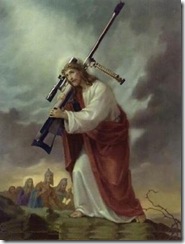
Jesus with a gun (borrowed from Seven Whole Days) Blogger Scott Gunn at Seven Whole Days is less subtle, and he writes less from a legal/constitutional point of view (although he agrees the practice is unconstitutional) than from his perspective as an Episcopal priest.  Apparently, the company spokesman dismissed critics of the practice as “uppity ‘non-Christians’”.  Gunn responds, “Well, this priest in Christ’s Holy, Catholic, and Apostolic Church is outraged.”

Where to begin? Let’s start with practical matters. It will (rightly) inflame Muslims to learn that US military forces are fighting a war with equipment that contains references  to the Bible … How can we have any credibility when we say we are not fighting a new crusade, while our forces use equipment that is marked with verses about following Jesus?

Continuing to speak as a priest, I am further outraged by the perversion of the faith to which I devote my life. Jesus surely wants us to share the Good News with the whole world, but not in the side of deadly weapons. More to the point, killing in Christ’s name violates every teaching of the Gospels. I might concede that war is a necessary evil, though I have strong pacifist leanings, but we can never imagine that we have God’s approval to fight wars. Every war, every weapon, and every death in battle represents a tragic sin. To mock Jesus Christ by stamping “the light of Christ” on a rifle scope is to engage in deadly blasphemy.

To lawyer Friedman, I say “Counselor, we join in your arguments.  Your comments are incorporated herein by reference.”  To Pastor Gunn, I say, “amen, brother.”

A scholarly ELCA response to Benne and Lutheran CORE

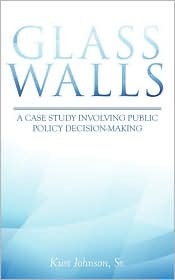
Kurt Johnson, Sr. is an ELCA Lutheran who resides in the Austin, Texas area.  He is the author of a political non fiction book entitled Glass Walls released in May, 2009.Glass Walls  The book discusses the neoconservative influence on the Bush administration’s decision to invade Iraq in 2003. 

GLASS WALLS is a flowing, descriptive study of how public policy decisions by government can be misguided by social, cultural and religious influences.

This post is not about the book but a subsequent paper by Johnson that discusses one of the neocon subjects of his book, Robert Benne.  This is the same Robert Benne who serves on the Lutheran CORE advisory board and who has authored several articles posted on the Lutheran CORE website, including the recent Why There Must be New BeginningsBased on Benne’s background in neocon politics, Johnson offers a paper in response to Benne’s New Beginnings article.  It is a scholarly paper (pdf format) that is more ponderous than a blog post, but it offers revealing insight into Benne and serves as a rebuttal to many of Benne’s positions.

Johnson briefly traces the Benne drift into neoconservatism (emphasis added).

[I]t is well documented that in the mid-to-late 1970s, Benne distanced himself significantly from his position embracing “social justice” and toward a distinctively white and middle-class (if not upper-middle-class) system of values. It is well documented that he became disillusioned with the civil rights movement and anti-war movement (Vietnam).

As part of that transition, Benne decided to take up with the “Chicago School” of economic theory as promoted by the economists at the University of Chicago, embracing the free-market ideas of Milton Friedman as distinguished from the long-accepted views of John Maynard Keynes. And perhaps most surprising because of its
remoteness from Benne’s pre-1975 views as a professor at the Lutheran School of Theology at Chicago was his position that “market arrangements” can (as per Benne quoting Assar Lindbeck) “reduce the need for compassion, patriotism, brotherly love and social solidarity as motivating forces behind social improvement.” And so, by the time the ELCA was being formed and attempting to engage the world on the cutting-edge issues, Benne already was in the process of retreating from it, aligning with the neoconservative values which are found substantively in the “white, middle-class, Euro-American composition.” All he needed to complete the schism was a virulent issue like human sexuality, which conveniently pulled the trigger.

Here are a few key points of Johnson’s rebuttal to Benne.

Based on his baseline premise that lifelong, monogamous, same gender relationships are necessarily sinful, Benne concludes that the ELCA willy nilly excuses sin and offers cheap grace.  I previously discussed this unquestioned assumption or paradigm here.  Johnson rightly argues that the ELCA has not gone into the business of excusing sinful behavior.  Instead, the ELCA now challenges the basic assumption of sinfulness and has achieved a paradigm shift in the church’s attitude about committed same gender relationships.

Benne offers significant criticism of the ELCA quota system, as if it is part of a “pervasive, deep-seated and well planned conspiracy to overturn Lutheran confessionalism and a Lutheran interpretation of scripture,” according to Johnson’s characterization of the Benne view.  Johnson responds:

The inclusive, so-called quota system was developed in order to integrate the church and a world in need of ministry and sanctification. It was not developed to overturn important aspects of Lutheran doctrine. It is true that the quota system could be viewed as a threat to those who want to have the ELCA dominated by a “white, middle-class, Euro-American composition.”

Johnson concludes by raising the recurring question of how religion reacts to modernity, and suggests that the answer of Lutheran CORE is an unsatisfying retreat to Reformation era tenets of traditionalism.

It is understandable that the traditional orthodoxy represented by the Lutheran Core movement likely will dismiss these emerging developments and call them liberal, secular and heretical. The problem with this position … is that traditional orthodoxy is not likely to reassess how its message can reach and find acceptance in a society and world which are trying to digest such fast-moving changes.

Johnson’s paper is lengthy, but it’s worth the read.

Will the Lutheran CORE financial boycott of the ELCA hinder efforts to help Haiti? UPDATED

Except for Pat Robertson and his 700 Club rant that suggested the Haitians deserved the hurricane that has devastated their country, the reaction of American religious communities has been swift and supportive, and this includes the ELCA.  Bishop Mark Hanson, who is both the presiding bishop of the ELCA and also the current president of the Lutheran World Federation, reported on Lutheran relief efforts, according to an ELCA press release:

CHICAGO (ELCA) — The Evangelical Lutheran Church in America (ELCA) is responding to the earthquake in Haiti through the Lutheran World Federation (LWF), wrote the Rev. Mark S. Hanson, ELCA presiding bishop, in a Jan. 13 letter to members.  Hanson, who is also president of the LWF, noted that the ELCA has committed substantial funds to support relief efforts, and encouraged members to share information and provide financial gifts.

The Jan. 12 earthquake caused considerable structural damage around the capital city, Port-au-Prince, and may have killed “more than a hundred thousand people,” Hanson wrote, quoting Haitian officials. Relief agencies’ immediate concerns were for the safety of survivors, plus needs for water, sanitation and communication.

In a brief interview, Hanson told the ELCA News Service that “this is a time for the ELCA to come together as we have so often done in our history.”  He said the church has the capacity to respond to human tragedy, and “members are called to bear witness to our faith by responding generously and working with partners” to provide relief.

The presiding bishop asked members to contribute financial gifts to the church’s relief efforts. Members can provide gifts online at http://www.ELCA.org/haitiearthquake or call 800-638-3522.

In his written message, Hanson noted that the ELCA already is responding through the LWF’s Haiti Program. “Given the devastation caused by this earthquake, the ELCA has committed an initial $250,000 from ELCA International Disaster Response for Haiti and has authorized an additional $500,000 as congregations respond both to the immediate needs and long-term rebuilding efforts,” he wrote.

Yet, when I scour the websites, press releases and blogs of Lutheran CORE, Lutheran Congregations in Mission for Christ (LCMC), and the WordAlone network, I see nothing.  I don’t infer that their members are uncaring, but organizations built on the negative, built upon being against something, seemingly have a hard time transitioning into the positive.  The reality is their focus is on ELCA bashing, and they do not have the infrastructure to deal with non-political religious matters.  Their whole focus is political and not mission or ministry.

Lutheran CORE spokesman Robert Benne’s touted article Why There Must Be New Beginnings itemized ten CORE goals (stated negatively as ELCA criticism, of course), and the one pertaining to foreign mission emphasized conversion of the heathens without mentioning medical, educational, disaster relief, or infrastructure development.

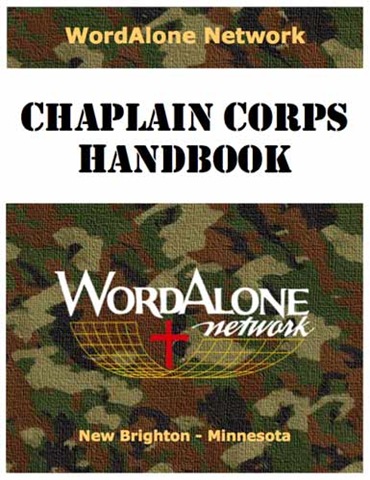
Chaplain corps handbook Even when WordAlone announces the formation of a chaplaincy corps, a closer look reveals more ELCA bashing, more political advice, more militancy.

The WordAlone Chaplain Corps is a new (launched January, 2010) program of the WordAlone Network through which pastors and laypersons alike may seek advice and counsel as regards the fallout from the positions taken by the ELCA pursuant to the church-wide assembly of that body held in August, 2009.

[From the booklet back cover] “Therefore take up the whole armor of God, so that you may be able to withstand on that evil day and having done everything to stand firm.”  (Ephesians 6:13)

The question needs to be asked: will the CORE financial boycott of the ELCA hinder efforts to help Haiti?  We know what these dissident organizations are against, what are they for?  We know that Lutheran CORE knows how to inflict pain through financial boycott, does CORE know how to heal?

UPDATE:

Pastor Justin Johnson offers his take on the silence out of Lutheran CORE, WordAlone, and LCMC.

The ELCA announced that its initial $250,000 contribution has already been increased to $600,000 based upon “a strong and generous response” from ELCA members.  If the rate of ELCA member giving continues, the ELCA contribution will soon exceed $1 million.

UPDATE TWO:

Please note my recent post  about Lutheran CORE spokesperson, Pastor Erma Wolf, urging financial support of the ELCA, especially for Haiti disaster relief, but perhaps also as a critique of CORE’s financial boycott generally.

ELCA Lutherans: Can we learn from conservative, Catholic retrenchment?

Open Tabernacle, the newly spawned progressive Catholic blog to which I occasionally offer ELCA tidbits, keeps spinning out one exceptional article after another.  Today, Bill Lindsey critiques the conservative retreat of the last two popes from the progressive reforms of Vatican II.  His post is directed at Catholics and Catholicism, but it occurs to me that there are parallels with the current Lutheran CORE / Wordalone conservative retreat from the progressive ELCA. 

There is a fundamental difference, of course, in that progressive Catholics such as Lindsey are the outsiders critiquing the Catholic establishment, but in Lutheranism, it is the conservatives who are the outsiders opposing the progressive ELCA.  There is also a difference between the hierarchy of the Vatican and the democratic polity of the ELCA.  Putting aside those obvious differences, is there wisdom in Lindsey’s post for Lutherans to apply to our own internecine struggles?

The focus of Lindsey’s post, inspired by fellow blogger Colleen Kochivar-Baker, is the shift away from the Vatican II emphasis on “internalizing theological insights and ethical values, as well as on the role of conscience and discernment in the Christian life” toward “rote memorization of dogmatic and moral formulas”.  Lindsey expands on the idea:

This shift moved Catholic intellectual life away from a post-Vatican II engagement with contemporary society in which Catholic thinkers listen to and learn from secular disciplines as they offer Catholic insights, values, and teachings in a process of dialogic give and take. Now the model for Catholic intellectual life—and for theologians in particular—became one of receiving “truths” from on high and handing these down to anyone who cared to listen.

Kochivar-Baker provided a personal illustration.  When she was an undergraduate at a Catholic University a generation ago, “she took courses in the documents of Vatican II that were intellectually demanding and required real thought and engagement.” 

Then down the road, her daughter took courses—same Catholic university, same professor—in moral theology in the period in which the restorationist agenda of Pope John Paul II and Cardinal Ratzinger (now Benedict XVI) began to roll through American Catholic theology departments.

She was able to pass these courses, Colleen notes, while hardly attending class. The syllabus spelled out in detail what the professor would teach. When Colleen asked about the shift in his pedagogical style—from challenging students to think, respond, and critique, to spoon-feeding them “truth”—he told her he was being monitored in class and lived in fear of being reported to the authorities for saying anything that transgressed the restorationist canon of truths.

Disturbing for Catholics and Catholicism, to be sure, but does this not sound a warning bell for the ELCA? 

Consider the following words of Lutheran CORE / WordAlone spokesmen.  Listen for a rejection of hard thinking–spirit led thinking, conscience bound thinking, reflection in dialogue with scientific disciplines–in exchange for a clear set of rules, a cookbook of moral recipes, handed down from on high.  Hear the Lutheran CORE call, if not for an infallible pope, then for infallible (and unambiguous) canon, creeds, and confessions.  Listen for the CORE promotion of their assumptions, their interpretations, their fossilized traditionalism–unquestioned and unchallenged by science or reason or conscience.  Certainty instead of ambiguity.  Learn the rules and don’t worry about moral discernment.

Therefore, the office of the papacy acts as a check, controlling the range of interpretation. The bishops share in this authority. 

So the congregation, the elders, pastors and theologians are linked together in a system of mutual watchfulness. The lay people, elders, pastors and theologians all look both ways, watching over each of the other layers of authority. Interpretation requires constant scrutiny, lest the interpreters be led astray.

[T]he idea that the Holy Spirit in the heart supersedes Scripture and sets aside all the normal standards. Having floated away into such a never-never land beyond the ordinary, in reality the August churchwide assembly has stranded the ELCA ecumenically.

Benedict XVI, the orthodox patriarchs and commonly the Protestant leaders as well, know both Scripture and the church’s tradition intimately—well enough to recognize the difference between the historically certain and the ambiguity of convenience.

James Nestingen

How ironic that a 21st century Roman Catholic pope and an archbishop can better articulate confessional Lutheran teaching than the ELCA churchwide organization.

Mark Chavez

When the first Lutherans lost the magisterial authority of the Roman Catholic Church, it had no sure authority to put in its place.

Modern Protestantism is an amalgamation of historic Christianity and the principles of the Enlightenment, its rationalism, subjectivism, and anthropocentrism. The underlying assumption is the neo-gnostic belief in the innerdwelling of God, such that everyone is endowed with the inner light that only needs to be uncovered. The light of truth does not shine through the Scriptures and the Christian tradition as much as through scientific reason and individual experience. This is what happened in Minneapolis: appeals to reason and experience trumped Scripture and tradition, punctuated with pious injunctions of Lutheran slogans and clichés. The majority won. And they said it was the work of the Spirit, forgetting that the Holy Spirit had already spoken volumes through the millennia of Scriptural interpretation, the councils of the church, and its creeds and confessions.

Carl Braaten

And, I might add, the Spirit having spoken in those long ago councils and creeds, better damn well keep her mouth shut these days.

The radicals so decisive in the defining moments of the ELCA intended to smash the authority of the influential theologians and bishops who had informally kept both the American Lutheran Church and the Lutheran Church in America on course. The radicals wanted many voices and perspectives, especially those of the “marginalized,” put forward in the ongoing deliberations of the ELCA. They were so successful that now, after 20 years, there is no authoritative biblical or theological guidance in the church. There are only many voices. The 2009 Assembly legitimated those many voices by adapting a “bound-conscience” principle, according to which anyone claiming a sincerely-held conviction about any doctrine must be respected. The truth of the Bible has been reduced to sincerely-held opinion.

Robert Benne

Allow me to conclude by paraphrasing the words of my fellow blogger, Bill Lindsey, to graft Lutherans into his post.

The move against Vatican II—the move to the right, the deliberate dumbing down of Catholic intellectual life and the punishment of critical thinkers that have been part and parcel of the restorationist agenda—is not merely a Catholic phenomenon. Restorationism is tied to a similar thrust within [Lutheran] life and culture to stop critical reflection from progressive standpoints, and to force progressive theological [Lutheran] thinkers into a right-leaning ideological conformity.
Is Lutheran CORE sexist?

My long-deceased uncle, raised in the back country of Louisiana in the 30’s and 40’s,  laughingly suggested he was twenty years old before he knew the phrase “damn Yankees” was two words.   This good ole boy couldn’t say or think “Yankees” without the adjective “damn”; it was a necessary coupling because “damn” defined the essence of “Yankees”.

And, I plead guilty to the same charge when the baseball team from the Bronx, the best team money can buy, is the subject.  The damn Yankees bought another world series last fall.

Oftentimes the adjective/noun coupling used by bloggers, commentators, columnists, etc. tell us more about the writer than the subject.  This is especially true in political discourse.  When we hear someone use the term “ultra liberal”, we know that the speaker really believes that all liberals are “ultra”.  This person can’t say liberal without thinking ultra.  It works for those of us on the left also.  When we say “arch conservative”, we betray our bias that all conservatives are “arch”.  The adjective doesn’t modify the noun but expresses the noun’s true meaning in the mind of the speaker.

Do adjective/noun couplings from Lutheran CORE spokesmen reveal a subtle sexism? 

Over the weekend at a CORE gathering in Sioux Falls, CORE speaker Ken Sauer criticized the ELCA (of course), and suggested that the ELCA began to go astray over twenty years ago when “radical feminism began pushing their views.”  [sic]  Does the coupling of the adjective “radical” with the noun “feminism” reveal more than Sauer may have intended?  Is Sauer betraying his belief that feminism is inherently radical?  Can Sauer say feminism without thinking radical?

Sauer is not alone.  Just a week or two ago, the much ballyhooed missive from CORE spokesperson Robert Benne entitled Why There Must Be New Beginnings blamed “hypersensitive feminism” as a significant problem for the ELCA from the beginning.  Can Benne say feminism without thinking “hypersensitive”?  Or, “militant feminism” as he states in a different article?

Nestingen in Sioux Falls The latent sexism of CORE / WordAlone spokesman James Nestingen is revealed, not by couplings of adjectives and nouns, but in his not-so-veiled criticisms of the 50% male-female gender quotas that produce voting members who lack “wisdom, fidelity and zeal” and are “the manageable, those eager to please” while those who are eliminated by the quota system (men?) “are the gifted and challenging”.  Benne openly states the obvious, “The losers, of course, are white male pastors”.

I have previously reported that CORE spokesmen promote a turn away from mainstream Protestantism (Methodist, Episcopal, Presbyterian, UCC) which all ordain women, and toward the conservative Lutheran Church Missouri Synod (LCMS), which does not.  What is it about the LCMS that CORE finds attractive, one wonders.  We presume Lutheran CORE doesn’t aspire to the heightened sexism of the Missouri synod (in some LCMS congregations, women may not even vote but are left to prepare coffee and cookies in the church basement while the men folk hold their elections upstairs).  After all, CORE boasts a pair of women on their advisory board.  And eighteen men.  Hmmm.

Meanwhile, the ELCA announces the following:

Ordaining women as pastors to serve Middle Eastern churches may become a reality. Delegates at the Fellowship of the Middle East Evangelical Churches (FMEEC) voted unanimously Jan. 12 to adopt a statement in support of this change.

The statement was drafted on the spot in response to a report by the fellowship’s theology committee, which found no biblical or theological reasons to oppose the ordination of women. The Rev. Munib A. Younan, bishop of the Evangelical Lutheran Church in Jordan and the Holy Land (ELCJHL), is president of FMEEC.

The vote occurred at the organization’s Sixth General Assembly. FMEEC is an association of evangelical (Anglican, Lutheran and Reformed) churches of the Middle East.

Sounds like the radical, militant, hypersensitive feminists are at work again.  Damn Yankees.