Author Archives: Obie Holmen

Did Obama have a good year?

The following is a quote from a blog aptly named Right Wing News, which attempts to set the bar for measuring Obama’s first year at messianic levels:

This time last year, I was told that once in office, President Barack Hussein Obama was going bring peace, prosperity, and all things warm and fuzzy to our beloved planet earth. All the national and international turmoil occurring at the time could be attributed solely to President Bush, a.k.a. the anti-Christ, including our two wars in Iraq and Afghanistan, and including any and all anti-American sentiment across the globe.

If only we had a God-like savior like Barack Obama to lead us out of despair, everything would be okay again. The world would stop sneering at us, nuclear proliferation would magically cease (because our enemies would be too busy kissing our president’s feet), and radical Islamic extremists would finally sit down and have tea with our leaders.

The right wing blogosphere is happily chirping at double digit unemployment and other indices that the economy continues to struggle.  Much as blowhard Rush Limbaugh was castigated for his comment that he hoped Obama would fail, the truth is that many applaud bad domestic and international news for the political damage that may inure to the Democrats.

Republican refusal to participate in governing our nation, preferring instead to “just say no” lest Obama be credited with bipartisanship, reflects the same politics first, country second mentality.  Even routine Senate business such as the year end defense spending bill meets a Republican filibuster—not that the Republicans don’t support the troops but because they smelled a political advantage.
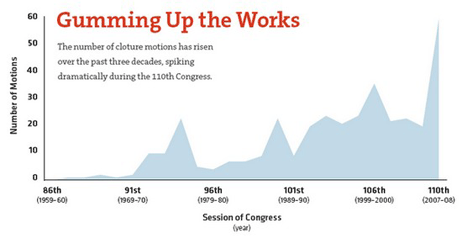
filibusters This chart, posted at Think Progess, shows the dramatic increase in the use of the filibuster in the last generation and exploding in the current Congressional session.  Many suggest that the Senate is broken, prompting Senator Harkin to announce that he will seek changes in the rules of the Senate since the filibuster is purely a self-imposed policy and not written into the constitution.

What does the public think?  Has the Republican “politics first” charade succeeded?  Is the chest-thumping of the right wing blogosphere justified?  Is the party of tea-party protests, death panels, and the filibuster swaying the hearts and minds of the American public?

Not so much. 

With a hat tip to blogger Pastor John Petty, a Gallup poll suggests the public is smarter than the Republicans think.  Here is the question posed by the Gallup pollsters Dec 11-13: “please tell me whether you consider each of the following to be a winner or a loser in politics this year.”

The results?  President Obama came out a winner by a 58-38% margin while the Republicans in Congress were nearly the opposite at 38-52%.  The poll showed even higher “winner” results for three women of Obama’s circle, First Lady Michelle, Secretary of State Clinton (long the bane of Republicans), and newest member of the Supreme Court Sonia Sotomayor (despite Republican opposition 31-9).

Maybe, just maybe, the Republicans would fare better if they actually chose to participate in governance instead of foot-dragging, obfuscating, and political manuevering.
Squirming #Lutherans of the #ELCA

American Lutheranism was imported by northern European immigrants, and the ELCA has long been dominated by blonde, blue-eyed folks whose favorite cuss word was “uff da”.  The ELCA has been intentional about expanding that base with inner city and minority outreach programs, but the effort suffered a setback with the departure of the Oromo group of churches, consisting of immigrant and first generation Africans, who share the strong homophobia of that continent (see the Ugandan legislative effort to execute gays).

Yet, there are evidences of the ELCA becoming more diverse. 

The ELCA departures consist primarily of those of northern European stock with a longing for an earlier day (not all—most of us of northern European ancestry don’t pine for the past).  A person commented on an earlier post here that she asked a question at a congregational gathering featuring a dissident speaker (LCMC representative) that received a telling answer. 

“What is an orthodox Lutheran?” she asked. 

The speaker responded, “your grandmother’s church”.

The lady who posed the question is 72 with one grandmother born in Norway in 1864 and the other born in Germany in 1882.   My point is merely that since the departures tend to represent a singular ethnic/cultural background, those who remain will naturally tend to be more diverse.

There is news out of the twin cities of Hmong ELCA ordinations.  A Star Tribune news article reported on the ordination of Minneapolis’ first Hmong pastor (St Paul already had a Lutheran Hmong pastor):

A Lutheran congregation in Minneapolis is celebrating Christmas with its new minister, the city’s first Hmong Lutheran pastor.

Nengyia Her was ordained Sunday as a minister in the Minneapolis Synod of the Evangelical Lutheran Church in America. He was also installed as pastor of Luther Memorial Lutheran Church in north Minneapolis.

The ELCA will certainly become more gay and less straight.  That may be what has the Lutheran CORE types squirming. 

I was a Goodsoil volunteer at the ELCA church wide assembly last summer promoting marriage equality and gay clergy, and I wore a distinctive prayer shawl.  During lunch one day, a pastor from a rural Pennsylvania congregation sat next to me, and his body language betrayed his unease at sitting next to a person he assumed was gay (I’m not; I happen to be a gay ally, but he didn’t know that).  He was polite but clearly uncomfortable. 

I have a counter story also.  At one of the daily assembly worship services, we blessed each other with the sign of the cross on one another’s forehead.  I happened to be sitting alone, and I shared the blessing with a lady behind me.  Another lady, sitting in my row several empty chairs away, feared that I had not been blessed and also assumed I was gay based on my prayer shawl.  After the service, she pointedly came up to me and offered another blessing even though I assured her I had already been blessed.

This brings up another irony in the whole Lutheran Core, ELCA schism issue.  On the one hand, CORE leaning congregations express frustration at their perception of the heavy- handed control by the ELCA; the reality is that local congregations are entirely free to consider gay ministry candidates–or not–at their congregational discretion.  The ironic falsity is that such local congregations are not really whining about the ELCA controlling them, but that they are upset that they can’t control what other congregations may do with their ministries.  Local control is not the solution; for the CORE congregations it is the problem.  In a metaphorical way, they are uncomfortable with sitting next to certain someones at the lunch table—or the communion rail.

There is anecdotal evidence of families returning to the ELCA who had left because of the treatment of a gay family member.  There is concrete evidence that the ELCA will become more gay in news from St. Francis Lutheran Church of San Francisco.

When St. Francis Lutheran Church called a lesbian couple in 1990 to minister to its members and the Castro community the congregation was put on trial and thrown out of the national body the Evangelical Lutheran Church in America (ELCA) in 1995. The congregation, in a combination of prophetic protest and tongue in cheek, has thereafter celebrated the Feast of the Expulsion on the last Sunday of the year.

But now, the congregation’s leaders have changed the name of the Feast of the Expulsion to the Feast of Hope, reflecting momentous changes in the ELCA this last summer when it finally caught up to the San Francisco congregation. Looking for eventual reconciliation, the congregation is hopeful that the finalized details of that change will not be a hindrance in any way to sexual minority rights -hence the renaming of the feast day.

This is news that will make some folks squirm a bit, I’m sure.  The speaker at the feast, held this past Sunday the 27th, was Pastor Anita Hill of St Paul Reformation church in Minnesota.

More legal advice from #Lutheran Core #ELCA

Last week I blogged about Lutheran Core “Education Director” Steven King offering legal advice to congregations considering a vote to depart the ELCA.  He continued as a “clubhouse lawyer” in his post yesterday.

The term “clubhouse lawyer” is a sports metaphor for an athlete griping, sniping, agitating, whining, and generally disagreeing with management in clubhouse chatter.  The metaphor fits Pr King’s blog post.  In essence, he is suggesting to those congregations that cannot obtain the necessary votes to depart the ELCA, that they nevertheless become a “thorn in the side” of the ELCA, and he offers a legal option to do so–while also resolving to withhold benevolence. 

Seems to be a lot of “whereases” and “therefores” in the ministry of Lutheran Core, but should that be surprising for a movement based on law and not gospel?

Post Christmas catchup #Catholic

After a Christmas blizzard that prevented our son and his girlfriend from travelling to our house, then pooped out, after an NFL weekend that identified the six NFC teams that will be playoff bound with seeding yet to be determined and an AFC with five 8-7 teams contending for two wildcard spots, after Christmas eve Senate passage of health care reform, after a failed attempt at terrorism over the Detroit skies, it’s Monday morning and time to return to the routine.

My novel publisher is busy designing a robust website to promote the novel, due for release in February, but I have to write the text that will appear on the various web pages.  That has been my task for the past several weeks, but I should finish today or tomorrow.  Yesterday, at a Christmas gathering of my siblings, 86 year old Dad, and numerous nieces and nephews, I received lots of kudos about the early novel reviews—tinged with hues of surprise.

I follow lots of blogs through my RSS reader, and this morning I sifted through the headlines of over 250 posts that had accumulated over the weekend.  It will take a few days and a few blogposts to sort it all out, but let me start the week by noting the passing of a great Catholic reformer.

Schillebeeckx in younger days I mentioned Edward Schillebeeckx in a recent blogpost about a Vatican II reformer whose path I had crossed, Godfrey Diekmann.  Here is a link to the press release from the Schillebeeckx foundation announcing the death of the 96 year old Catholic reformer; another to a Vox Nova blog post, which has an interesting string of comments, pro and con, that speak to the current retrenchment of Roman Catholicism to pre-Vatican II conservatism; and to the National Catholic Reporter, which contains a lengthy and well spoken obituary that concludes:

[T]hough he was keenly aware of the hierarchical church today and had no misapprehensions about the direction in which it seemed to be heading. This is what he said in 1990:

“My concern is that the further we move away in history from Vatican II, the more some people begin to interpret unity as uniformity. They seem to want to go back to the monolithic church which must form a bulwark on the one hand against communism and on the other hand against the Western liberal consumer society. I think that above all in the West, with its pluralist society such an ideal of a monolith church is out of date and runs into a blind alley. And there is the danger that in that case, people with that ideal before their eyes will begin to force the church in the direction of a ghetto church, a church of the little flock, the holy remnant. But though the church is not of this world, it is of men and women. Men and women who are believing subjects of the church.”

America, the National Catholic Weekly, also contains an excellent article that speaks of the “Dominican priest who advised the Dutch bishops at Vatican II and became a major figure in the Church’s efforts to implement the reforms of that Council in the decades that followed.”

In a related note, blogger Terence Weldon of the UK notes a movement in his country to “stand up for Vatican II”.  Indeed, that is precisely what US based Catholic reform movements such as Call to Action, Voice of the Faithful, and a host of others seek as well.  The next 5-10 years will be fascinating to follow progressive Catholics in opposition to an increasingly conservative, patriarchal, and hierarchal institutional church.

#WordAlone legalism: “Tilting at Windmills” #ELCA #Lutheran Core

He had scarcely gone a short league, when Fortune, that was conducting his affairs from good to better, discovered to him the road, where he also espied an Inn. Sancho positively maintained it was an Inn, and his master that it was a castle; and the dispute lasted so long that they arrived there before it was determined.  Miguel Cervantes, Don Quixote

Since WordAlone and Lutheran CORE share headquarters in New Brighton, Minnesota, one wonders if the two are really one, especially since both camps reek of the same anti-ELCA manure.  The separate websites of the two organizations exhibit significant cross-fertilization.

Tell me thy company, and I will tell thee what thou art.

The latest stink comes in a WordAlone blog post from Pastor Steven King who is listed as WordAlone’s Education Director, but his articles also appear on CORE’s website.  In his post, King accuses certain ELCA bishops of “non-constitutional policies”, “heavy-handed attempt”, “misleading congregations”, “misconduct”, and “unconstitutional meetings”.  He urges those who promote congregational ELCA exit votes to prepare for legal proceedings in the event they lose at the ballot box.

Fear has many eyes.

And what is this egregious misconduct of the bishops that warrants harsh condemnation and is grounds for legal action, according to King?  It seems certain busy bishops have the temerity to send a representative (bishops’ assistant?, synod staff?) instead of appearing personally for consultations with congregations in the midst of the process of withdrawal.

Once a literalist, always a literalist.  Once a legalist, always a legalist.

Don Quixote: Dost not see? A monstrous giant of infamous repute whom I intend to encounter.

Sancho Panza: It’s a windmill.

Don Quixote: A giant. Canst thou not see the four great arms whirling at his back?

Sancho Panza: A giant?

Don Quixote: Exactly.

From the Man of La Mancha

Liberal and religious??

When I began this blog eight months ago, I chose the title, “Spirit of a Liberal”, and its theme, “a blog of progressive, religious themes” as intentional, in-your-face statements.  I favor unfettered intellectual inquiry, on the one hand, but also embrace the mystery, on the other.  I reject the hatred and bigotry clothed in Christian themes (“who wants to be lumped in with all the other Christians, especially the ones you see on TV protesting gay marriage, giving money to charlatans, and letting priests molest children?”) while accepting the moments of spiritual fulfillment in my own life.  Calvin was mostly right; our rituals, symbols, and myths are just that, but he was wrong when he said they were mere symbols.  We speak our unspeakable truths in our mythologies.  We doubt, and we hope.  The Old Testament book of Job, with all its uncertainties, is my favorite Biblical book; if only the editor hadn’t added a sappy, happy ending.

Elaine Pagels, a professor of religion at Princeton and acclaimed author of Beyond Belief and other works, spoke of her own faith journey as a fallen evangelical whose academic pursuits conflicted with the unthinking literalism of her youth; yet, when faced with the death of her child, she found herself back in a church because it “spoke to my condition”.

I happened across a superb article entitled, “I am a closet Christian”, which marvelously expresses similar sentiments.  Brooklynite Ada Calhoun shares her faith journey in the article, and her theme about religion in general and Christianity in particular is summed up in her line, “Not how it’s right or just, but how — and this may sound stupid, but it’s what I think about religion in general — it works.”

Here’s a longer statement:

All of us need help with birth and death and good and evil, and religion can give us that. It doesn’t solve problems. It reminds you that, yes, those challenges are real and important and folks throughout history have struggled and thought about them too, and by the way, here is some profound writing on the subject from people whose whole job is to think about this stuff.

The idea of an eternal community brings me comfort: I like the image of a long table extending backward and forward in time, and everyone who’s ever taken Communion is sitting at it. The Bible at the 1920s stone church where my husband and I were married was filled with the names of people in the community who’d married, been born and died. When my son was baptized in our church in a traditional Easter eve service, the light spreading from candle to candle through the pews of the dark church made me feel, at least for one moment, we were united in a sense of gratitude for new life and awe in the face of the numinous.

Please read the whole article.

A Wretched Man novel: 2nd review is in

I earlier quoted the first review/recommendation that my soon-to-be-released novel received.  Advance Reader Copies of the novel have been sent to potential reviewers in anticipation of the novel’s February release.  Today, my publisher advised me that a second recommendation came in over the weekend.  Here it is:

current copy resized A Wretched Man: A Novel of Paul the Apostle is a stunning fictional account of the early church that reads like real-life. While a work of fiction, this just may be the most authentically historical novel ever written about the lives of the apostles. Robert Holmen is a wonderful writer with a gift for bringing the Roman and Jewish worlds of the first century to life in an incredibly realistic way. Holmen’s marvelous prose made me feel as if I was actually there witnessing the events described. This is the first biblical drama I have ever read that presents the apostles as real flesh and blood human beings struggling with the all-too-human issues we all face. The internecine struggles waged by Paul, James, and Peter in this book are still with the church today. This is a story that will both shock and inspire any Christian who is truly searching to find and follow the historical Jesus. It has certainly deepened my own understanding of my faith.

Rev. Jeffrey Bütz, instructor of Religious Studies, Penn State University, and author of The Brother of Jesus and The Secret Legacy of Jesus

Gay friendly evangelicals?

Is “conservative evangelical” a redundancy?  Aren’t all evangelicals conservative?  I recently cited a New Jersey poll that suggested that Roman Catholics, Jewish, and mainstream Protestants held similar, positive views on marriage equality (about 10-15% more favorable than unfavorable), but that evangelicals were overwhelmingly negative.

Rev Mark Tidd As a generalization, the perception holds– most evangelicals are conservative.  But, there are exceptions.  There is a major news story out of Denver about a startup mission church that is evangelical and openly affirming of gays and lesbians.  The Rev Mark Tidd is Pastor of Highlands Church in Denver, which is a new satellite congregation of Pathways Church.  Tidd was initially on the staff at Pathways.

Highlands didn’t begin with a gay affirming policy, but Tidd soon began the Sunday service welcome with the words, “queer or straight here, there’s no hate here.”  Many were upset and much of the original membership gains were lost.  Over two months, half the membership and 2/3 of the financial support departed Highlands.  The relationship with parent church Pathways was also strained but not broken, and they continue to work together on some things like an upcoming service project trip to New Orleans.

After these setbacks, attendance at Highlands is again on the upswing, and it will be interesting to follow the course of Highland’s development. 

David Dockery, president of Union University, a Southern Baptist school in Jackson, Tenn., believes Highlands is — and is likely to remain — outside of the mainstream of evangelical churches.

“I don’t think it can be taken for granted anymore that the traditional evangelical view will be adopted by the coming generations given the changes and shifts in our culture,” Dockery said.

That makes it all the more important, he says, for evangelical leaders to clearly teach the traditional views on homosexuality.

There is also a nationwide ministry called Evangelicals Concerned.  It would appear that the western region of that organization is the most active with a blog and a website , which offers the following mission statement:

Evangelicals Concerned (EC) is a nationwide ministry which encourages and affirms lesbian, gay, bisexual and transgendered Christians in their faith. We organize small groups, bible studies, social activities and other events in many North American cities, and we organize national and regional conferences every year.

EC holds that the love and Grace of God is available to all persons through Jesus Christ. We believe that human delineations such as race, gender or sexual orientation are not held relevant by our Creator.

An ELCA Lutheran Pastor’s letter to his riled up congregation UPDATED with vote totals

My friend Susan Hogan has quoted a very lengthy letter in her blog, Pretty Good Lutherans.  Go and read it.  It is a pastoral letter from Pastor Eric Lemonholm to his congregation at Grace Lutheran Church of Detroit Lakes, Mn on the eve of its vote to withdraw from the ELCA.

I believe that it would be a serious mistake for Grace to leave the ELCA, and I urge you to prayerfully consider voting “No” on December 20. Let me tell you why.

That sums up his position, and he goes to great lengths to support it. It’s a sound and well reasoned letter and worth ten minutes to read it and much more to reflect on his wisdom.

UPDATE:

Apparently, the pastoral letter helped: the final vote yesterday was 98 to stay ELCA and 42 to leave.  The 40% vote to leave fell far, far short of the 2/3 majority necessary to pass the resolution.

Good luck to Pastor Lemonholm and the congregants of Grace as they now begin the process of healing.

Deja Vu all over again

Pastor Gail Sowell “Deja Vu all over again,” is attributed to Yogi Berra.  Somehow, it fits.

There is a news report about the experiences of a small town Wisconsin congregation of the ELCA that brings back memories.  The experience of St. John Lutheran Church of Edgar, Wisconsin mirrors that of my former church, Gethsemane Lutheran of Upsala, Minnesota, twenty-two years ago.

Late in 1987, the Gethsemane council voted 11-1 that Gethsemane would not join the ELCA on the occasion of the merger that would go into effect on Jan 1, 1988.  My wife was the one dissenter.

Emotions were high, members were polarized and lay leaders in both congregations wanted to vote quickly to leave the ELCA.  St. John congregational council members held a meeting that first week [after the 2009 Church wide assembly] and voted unanimously, with one abstention, to recommend the congregation leave the ELCA.

Several high tension congregational forums were held at Gethsemane.  Opponents of the newly formed ELCA attacked Lutheran Social Services (LSS) as promoting pornography.  The ELCA didn’t take the Bible seriously enough, it was said, since the ELCA used a watered-down word “inspired” instead of “inerrant”.

[St John in Edgar] held two congregational forums, on Oct. 18 and Nov. 1.  The Oct. 18 forum was particularly nasty, with many members reported to be “yelling and screaming” at one another.

At the January 1988 Gethsemane annual congregational meeting, a motion was made to rescind the action of the Council (which was probably unconstitutional anyway), and the vote was approximately 60% to stay ELCA and 40% to leave.  Many of the conservatives quit the council and quit service positions such as Sunday school teachers.

What happened next was a surprise to many.  St. John members voted 106-67 on the proposal to leave the ELCA, but failed to achieve the required two-thirds by four votes.  That night the council and other congregational leaders met and resigned their leadership positions.  The one exception was the deacon who had earlier asked his colleagues to slow down.

New leadership emerged at Gethsemane, and members stepped forward to replace those who had resigned from the council, to teach Sunday school, and to accept other responsibilities.  While the conservatives stopped giving benevolence, others dramatically increased their financial support of the congregation.

[The first Sunday worship after the St John vote] was another surprise: 145 people showed up for worship — the most that had been there since [the assembly].  “We had people come back who had stopped coming at least since the Oct. 18 meeting,” [Pastor Sowell] said. With a shortage of Sunday School teachers, the result of the previous week’s resignations, six people volunteered on the spot to teach, Sowell said.  Since that time, “dozens and dozens” of members have stepped forward to volunteer for various roles at St. John.

A refreshing spirit of hope and “can do” lifted Gethsemane in the next several years despite the departure of most the conservatives who formed their own Free Lutheran congregation.

“The next Sunday I saw such warmth in the people that were left.  We’ve seen a real consensus of people who really wanted to make this work.”

In the 90’s, Gethsemane took on a building project to replace their 100 year old building.  Half the necessary funds were raised during a fund drive, and the balance on the mortgage is now nearly paid off on the brand new church building that went into service in 1997.

  [T]he situation at St. John was “like a death and resurrection experience.”

“I have grown so much because of this,” [Pastor Sowell] said. “I have been carried by the prayers of my former congregation.  People have called me out of the blue to say, ‘I’m praying for you.'”

“I am sure St. John is not only going to survive, it’s going to thrive,” Sowell said.

Based on my own experience at Gethsemane, I’m sure Pastor Sowell is absolutely correct.  Good luck, Pastor Sowell, and the rest of the reinvigorated congregants of St. John’s.  We’ll be praying for you.  Check out Gethsemane’s website and see what’s happening at a congregation that survived and thrives still.