Author Archives: Obie Holmen

Full inclusion of all the baptized in all the sacraments

I am following the Episcopal general convention through several RSS feeds, and one of the best is through Integrity USA’s blog, “Walking with Integrity”, which provides their own YouTube video updates entitled, “IntegriTV”. Integrity USA is the LGBT advocacy group within the Episcopal Church, and their motto is “full inclusion of all the baptized in all the sacraments.”

Yet, what seems so simple, obvious, and Christ-like remains an unrealized ideal in so many settings.

An ELCA pastor friend of mine married a country gal from South Dakota whose father was the local county sheriff, and the family belonged to a Missouri Synod congregation. When the newlyweds first visited, elders within the church kindly informed the sheriff that his new son-in-law would not be welcome at the table. The sheriff and his wife did the right thing and promptly resigned their membership in the congregation they had belonged to their entire lives.

Years ago when I took graduate classes at St John’s School of Theology in Collegeville (a Benedictine Community), I was a welcome addition as a Lutheran. The students consisted of three categories a) candidates for the priesthood, b) nuns and other Catholic women, and c) miscellaneous protestants such as myself. One evening a week, the resident students invited the non residents to a meal in the dorm dining room followed by a prayer service and Eucharist. Protestants participated in the Eucharist until a couple of priest candidates objected, and with much pain on the part of most of the Catholic teachers and students, the practice ceased.

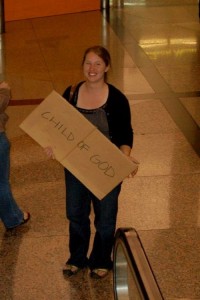
child of god
A blogpost this morning tells another tale of pain following rejection at the Lord’s Table. Blogger Sarcastic Lutheran reports an 11 am Sunday phone call:

Finally in a shaky voice, this came out: “I’m at my parent’s church….they are doing communion…..and I’m not allowed to take it.”

The blogger is the mission developer for “House for all Sinners and Saints” — “a group of folks figuring out how to be a liturgical, Christo-centric, social justice oriented, queer inclusive, incarnational, contemplative, irreverent, ancient – future church with a progressive but deeply rooted theological imagination.” She did the right thing and brought Eucharist to the young woman at the Denver airport.

The Rainbow Sash folks over in the Catholic Church seek to let the rest of their church know their pain of exclusion as LGBT persons.

When James, the brother of Jesus and leader of the church in Jerusalem, sent word to Antioch that Peter must refrain from table fellowship with unclean Gentiles, Paul understood the pain of exclusion, left in a huff, and the mission of the Apostle to the Gentiles began in earnest. History reminds us that we must ever fight the good fight, even when church leaders warn against rocking the boat.

A word from the conventions, Part II: UCC, Episcopal, ELCA

An earlier post reported on the closing of the Mennonite USA convention and the opening of the United Church of Christ (UCC) General Synod. Since then, the UCC has concluded its business; meanwhile, the triennial General Convention of the Episcopal Church will convene in Anaheim on July 8.

Ballots

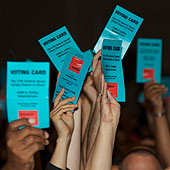
The main order of business for the UCC was the pro forma election of The Rev. Geoffrey Black to succeed the Rev. John Thomas as General Minister and President. Thomas was ineligible for an additional term. That Black was selected without opposition symbolized the unity and lack of divisive issues at the 27th General Synod. The UCC is one of the mainline Protestant denominations that welcomes gay clergy, and they appear to be at peace with the issue.

The Episcopal Church is also a denomination that ordains gay clergy, but the issue continues to roil. At the 76th General Convention since 1785, LGBT issues will dominate:

The Episcopal Church’s 45-year debate over human sexuality and the appropriate response to the desire of lesbian, gay, bisexual and transgendered people to participate fully in the church’s life will occupy General Convention’s attention once again as it meets July 8-17 in Anaheim, California.

Deputies and bishops are being asked to reconsider the 2006 convention’s stand that the church “exercise restraint by not consenting to the consecration of any candidate to the episcopate whose manner of life presents a challenge to the wider church and will lead to further strains on communion.”

Episcopal News Service, July 6, 2009

The Episocopal Church is part of the worldwide Anglican communion, and the 2006 resolution sought to mollify international concern with the episcopacy of gay Bishop Eugene Robinson of New Hampshire, in a classic “don’t rock the boat” expression of church polity over principle. As the 2009 General Convention approaches, the Episcopalian blogosphere is electric with anticipation.

Elizabeth Kaeton, a self-described “joyful Christian who claims the fullness of the Anglican tradition of being evangelical, Anglo-Catholic, charismatic, orthodox and radical”, serves as Pastor of an Episocopalian parish in New Jersey. In her “Telling Secrets” blog, she has a telling video that addresses the perception that all African Anglicans have a negative attitude toward gay inclusion.

From the opposite coast, Pastor Susan Russell of California offers regular updates and a photo montage of the Integrity Team in preparation for the General Convention at her “Inch at A Time” blog. Pastor Russell also serves as President of Integrity USA, “a faithful witness of God’s inclusive love to the Episcopal Church and the lesbian, gay, bisexual, and transgender community. We are working for the full inclusion of all the baptized in all the sacraments,” and the Integrity blog also has frequent updates.

Meanwhile, ELCA members and churches continue their 50 day prayer vigil that points toward their 2009 Churchwide Assembly in Mpls that begins August 17 and which will consider the ELCA versions of LGBT resolutions. I plan to be present in MPLS to liveblog the daily events.

New York Minute

My wife and I love to visit NYC, and we have had plenty of opportunities since our eldest began college at Eugene Lang / The New School in the mid nineties. After a few years in Chicago, she returned to permanent residence in Brooklyn seven years ago.

But now she is at one of those life moments when she needs the solace and sanctuary of home, and I helped her move back to Minnesota late last week. On Wednesday morning, I departed Northfield, Mn and traveled the 1200 miles to Brooklyn in my SUV in a day and a half. Thirty six hours after crossing the Brooklyn Bridge, the SUV headed back to Mn pulling a UHAUL filled with books and her meager worldly goods. Daughter and dad arrived back in Northfield in time for Mom’s Sunday birthday. After 2500 miles on the road in four plus days, I am ready for a little downtime at the computer while daughter locates the nearest Yoga studio.

The first time I journeyed from Mn to NYC was in the fall of 1966 as my parents drove me to my freshman year at Dartmouth. This small town boy was scared shitless. We spent a few days in the big city with Dad’s brother Lloyd serving as tour guide. The Empire State Building, street celebration in Little Italy, fancy German restaurant that loaned us ties when we entered, and the rest is a blur.

In recent years with our daughter living in Brooklyn, we have enjoyed the occasional Broadway show, the singing wait staff at Ellen’s Stardust Diner, the subway, Tom’s Breakfast diner on Washington Avenue in Brooklyn, the west village, Brooklyn botanical gardens, and getting to know our daughter’s eclectic New York friends.

Now, as we journeyed west, I shared memories of my own pilgrimages back and forth across the upper tier of states east of the Mississippi. During the Dartmouth years, there were numerous road trips along the I-80, I-90 corridor. I’m not sure if my daughter paid much attention to my reminiscing about the flat tire blowout in the fast lane of the Dan Ryan Expressway around Chicago, the side trips into Canada at Buffalo and reentry at Detroit to avoid toll roads, the ritual bar stop for a quick beer in Whitehall, New York after crossing Vermont to celebrate the 18 year old drinking age, the deer that we hit in Wisconsin, the night spent in the Tomah, Wisconsin jail after getting a 2 am speeding ticket without enough cash to pay the fine, and other Kerouac/On the Road moments.

The world has turned countless times since I first followed these freeways and toll roads over forty years ago. I suspect those concrete paths are much the same now as then. Even if my daughter wasn’t listening to my stories, I was.

A word from the Conventions: UCC, Mennonite, NOW, ELCA

The United Church of Christ General Synod convened in Grand Rapids, Michigan on Friday, June 26, and will adjourn on Tuesday, June 30th. The 27th synod is graced with 3,500 attendees. Here are a few highlights, so far.

Trinity UCC in Chicago made headlines last year as the home church of Barack Obama and fiery Pastor Jerome Wright. Pastor Wright has retired, but the church was represented by Pastor Otis Moss III who delivered an impassioned sermon to the gathered on Friday night.

God says I am the Alpha and the Omega, COMMA, who is, COMMA, and who was, COMMA, and who is to come, COMMA.

In a mind-jolting, three-minute recitation of the history of Christianity, Moss shouted a COMMA between each event, all the way through to the 1957 creation of the United Church of Christ and the presence of John Thomas as General Minister, who introduced him Friday night.

Don’t get angry with the haters, the Rush Limbaughs. Next time you hear them, just say, ‘COMMA!’ When you see Dick Cheney, just say, ‘COMMA!’ Remember, there used to be a period on Pennsylvania Avenue. At Calvary, death wanted to place a period, but Jesus got up on Sunday morning. ‘COMMA!’

Official actions of the synod will include the election of a General Minister and President of the UCC, Conversations on Race (a theme introduced by outgoing General Minister John Thomas within the last year) consisting of various workshops and discussion centers, seventy new UCC congregations were highlighted and celebrated, journalists Eugene Robinson and Ray Suarez addressed the assembled, all punctuated with commas, shouts, singing, and dancing.

Daily digests of synod happenings are available at the UCC website.

As the UCC General Assembly closes on the 30th, the Mennonite Convention 2009 convenes in Columbus, Ohio and will run through July 5th. The theme is “Breathe and be Filled,” and a Youtube video provides the anticipation.

Daily happenings can be followed at the Mennonite USA website.

Meanwhile, at the National Organization for Women (NOW) convention that adjourned a week ago, a new leadership slate was chosen. Terri O’Neill’s team, which takes office July 21, includes Bonnie Grabenhofer of Illinois as Executive Vice President, Erin Matson of Minnesota as Action Vice President, and Allendra Letsome of Maryland as Membership Vice President.

Finally, many ELCA congregations nationwide are answering the Presiding Bishop’s call for 50 days of prayer in anticipation of the Churchwide Assembly that will convene in Mpls on August 17th. The much anticipated assembly will deal with major resolutions regarding LGBT issues including gay clergy and same-gender marriage.

I plan to be present at the assembly to provide live-blogging updates.

UPDATED: June 28, 1969: Where were you? Stonewall remembered.

Many of you probably weren’t born, so I guess this is a question for the baby boomers, like me. But, I encourage the young’uns to read along, anyway, to get a better understanding of who and where we are this Sunday, the fortieth anniversary of Stonewall.

Here’s my answer. I had just turned 21 and had just finished my army infantry training in the heat and amongst the snakes and spiders of Fort Polk, Lousiana, “Fort Puke, the arm pit of America,” we called it. Pilfered from www.imjinscout.com/fort_polk1.html“If’n one of them coral snakes bites ya, here’s the proper military procedure,” droned the drill sergeant. “Spread yer legs to a comfortable military stance, put yer hands on yer knees, bend down at the waist as far as you kin, and kiss yer sweet ass goodbye.”
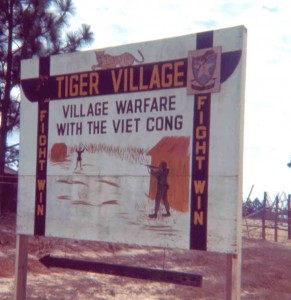
A few weeks earlier, over Memorial Day weekend, our battalion received back to back three day passes, a rare treat toward the end of our training. We were all headed to Viet Nam to become “grunts”, anyway, might as well allow us a good time. My new girlfriend of less than six months drove down from Minnesota — along with my parents, brother Mike, and his girlfriend — and we all camped out at Aunt Carol’s place in nearby Lake Charles. In front of a sultry red sun of dusk, under the bearded Spanish moss that hung from the live oaks that leaned over a dusty country lane, I had proposed, but the girlfriend had turned me down.

But now, three weeks later, I was back in Minnesota on a 30 day leave before departing for my one year tour of duty as an infantryman in Viet Nam, and the girlfriend had finally consented under my relentless urgings, and she allowed me to purchase an engagement ring. I needed that lifeline, that sense of committment and belonging, that sense that there was a future beyond the jungles of Southeast Asia, and her assent to one day becoming my bride gave me that grounding. Lynn still wears that ring, today. I didn’t know then what a privilege it was to ask the one I loved to be for me; to hold my hand and keep my heart close; to send and receive trite, and silly, and melancholy missives; and to wait and to be there when I returned.

Bobby Dylan was singing and saying that the times were a’changing, but it wasn’t clear in what direction. Tricky Dick was in the White House. Dion was lamenting the losses of Abraham, Martin, and John: “but it seems the good, they die young,” and in my narcissism I knew the song was about me. I wasn’t much concerned about what was going on in Greenwich Village, NYC.

If there were any gay people in my life then, I didn’t know it. Oh, there was elderly Emil, a hapless figure who would buy the small town boys cigarettes, but we all knew not to go behind any buildings with him. Maybe some did, I don’t know. I suppose somebody had to be the source of the giggling about the comic old man. In hindsight, I know that an older cousin later died in alcoholic squalor, never fully able to come to grips with who he was, and I have a younger cousin who thrives in a long term relationship with Robert. Perhaps there is symbolism in the differences between the older and the younger. In a reunion with my younger cousin a few years ago, he laughingly recounted how he loved to come and spend time with us in Minnesota and with dear old Grandma Olga because she allowed him to dress up in girl’s clothes.

Queers were deviates, so said the medical and psychological establishment. Fags were outlaws and security risks, so said the FBI, State Department, US Postal Service, as well as state and local law enforcement agencies. Homosexuals were sinners who had chosen the wrong path and needed repentence, so said the word from Christian pulpits. And these others, whoever they were, were mostly invisible:

a secret legion of people, known of but discounted, ignored, laughed at or despised. And like the holders of a secret, they had an advantage which was a disadvantage, too, and which was true of no other minority group in the United States. They were invisible. Unlike African Americans, women, Native Americans, Jews, the Irish, Italians, Asians, Hispanics, or any other cultural group which struggled for respect and equal rights, homosexuals had no physical or cultural markings, no language or dialect which could identify them to each other, or to anyone else.

Dudley Clendinen and Adam Nagourney, as quoted in the Wikipedia article on Stonewall. Whatever you may think of Wikepidia generally, I urge to read the lengthy article about the Stonewall riots.
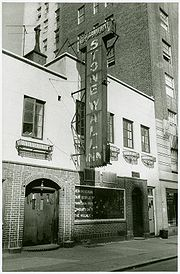
Stonewall Inn When the eight police officers knocked on the Stonewall door at 1:20 a.m., June 28, 1969, and announced “Police! We’re taking the place!”, they didn’t know they were about to make history, any more than the bus driver who ordered Rosa Parks to surrender her seat on the Montgomery, Alabama bus to a white passenger 14 years earlier. Spurred by the successes of the civil rights movement, the bra burning feminists, and the college students protesting the war, the response of the gay community of Greenwich Village to the routine police raid on the Stonewell Bar of Christopher Street, said Dylan was right, the times were a’changin’.

We all had a collective feeling like we’d had enough of this kind of shit. It wasn’t anything tangible anybody said to anyone else, it was just kind of like everything over the years had come to a head on that one particular night in the one particular place, and it was not an organized demonstration…. Everyone in the crowd felt that we were never going to go back. It was like the last straw. It was time to reclaim something that had always been taken from us…. All kinds of people, all different reasons, but mostly it was total outrage, anger, sorrow, everything combined, and everything just kind of ran its course. It was the police who were doing most of the destruction. We were really trying to get back in and break free. And we felt that we had freedom at last, or freedom to at least show that we demanded freedom. We weren’t going to be walking meekly in the night and letting them shove us around—it’s like standing your ground for the first time and in a really strong way, and that’s what caught the police by surprise. There was something in the air, freedom a long time overdue, and we’re going to fight for it. It took different forms, but the bottom line was, we weren’t going to go away. And we didn’t.

Michael Fader quoted in the same Wikipedia article.

Will the occasion be noted from any pulpits this Sunday? Some, I hope, but only a few, I fear. Probably not in my own church, even though I know my pastor is willing, but the congregation isn’t ready. Not yet. But, someday, and sooner than you think. It’s blowin’ in the wind.

UPDATE:

Here is a list of links to other blogs or websites discussing the 40th anniversary of Stonewall.

Twin Cities Pride (including info about 2009 Pride Events)
Kate Clinton: Stonewall 40
The Gifts of Stonewall – 40 Years Later
Pride in the South Central Region
Stonewall, 40 Years Later, What Has Been Achieved?
Weekend Video Roundup: Why We Fight (Idaho Edition)
Stonewall Remembered
Quick check of denominational news

This blog contains a page (see the sidebar) called From Headquarters that contains RSS feeds downloaded from the official websites of progressive denominations or religious organizations. For those of you unfamiliar with the concept of an RSS feed, it is a subscription to real-time updates of the latest entries from a website or blog. The feed is typically a headline that a reader can click on for the whole story.

Here’s a sampling of the headlines that appear as this post is being written.

From the Alliance of Baptists website, we see the headline “Being Ecumenical” which is a clickable link to the full story that starts with the following paragraph:

During my initial involvement as a representative of the Alliance of Baptists at the National Council of Churches, I grew to realize that all I need to know about ecumenism, I learned in Hurdle Mills, N.C. — not from my home church, but from the farming community in which I was nurtured.

Here’s another. From the official website of the ELCA, we see the headline, “Lutherans Open their Church Doors to Immigrant Families”, which clicks to the following opening paragraph from the ELCA news service article,

CHICAGO (ELCA) — For Howard Lamont being welcoming to the immigrant population is “simply part of the Christian message.”

And another. From the Mennonite Church USA comes the headline, ” Mennonite Church USA Convention 2.0″, and the clickable link takes the reader to a news release of instructions for following their general convention online.

NEWTON, Kan. — Mennonite Church USA Convention 2009 will take place in Columbus, Ohio, June 30 to July 5, but people who don’t make the trip physically can still experience convention on the Internet like never before.

And finally, one more. From the Action Center for Reform Judaism comes the headline, “At Interfaith Service, Saperstein Stresses Urgent Need for Health Care Reform”, and the link will take the reader to the full article about the comments of Rabbi Saperstein.

WASHINGTON, D.C., June 18, 2009 – At today’s Interfaith Service of Witness and Prayer for health care reform, sponsored by more than 40 national faith organizations and religious denominations, Rabbi David Saperstein, Director of the Religious Action Center of Reform Judaism, spoke of the pressing need for health care for all and encouraged our nation’s leaders to pass health care reform legislation this year.

So, the point is that this page of headlines From Headquarters is a quick and easy way to see what’s up as reported by various religious organizations. I hope you find this tool to be handy and helpful.

Schism is in our genes

Those of us in the Judao – Christian family tree have a long history of internecine struggle and splits. I suppose we could go back even earlier and talk about Isaac and Ishmael if we want to include the Muslims in this family history. The Pharisees disagreed with the Sadducees over Torah and the Temple, and the Essenes had enough of each and ran away to the desert. Paul split with Peter and started his own Gentile mission apart from the Jewish Jesus movement in Jerusalem. Later, the Christians and the rabbis disagreed over who could worship in the synagogues. First, the Coptics retreated to Egypt; then, the Greeks packed up for Constantinople leaving the Catholics in Rome; and a millenium later, Luther spewed nourishment to new nestlings.

So why should I be surprised when several blogposts come through my RSS reader today about schismatics in today’s christendom?

Several hundred former Episcopalians, meeting in a school gym near the Dallas-Fort Worth airport, ratified a constitution Monday for the fledgling Anglican Church in North America as a direct challenge to the Episcopal Church USA and the Anglican Church of Canada.

So says the Washington Times online.

Frederick Clarkson in Talk to Action blog points out that noted evangelical Rick Warren spoke at this meeting, inciting the schismatic sentiment.

The Presbyterians apparently have the same schismatic genes. According to Pastor John Shuck on his Shuck and Jive blog:

When the two main branches of the Presbyterian Church finally decided the Civil War had ended in 1983, they reunited. Ten years prior to reunion, some congregations of the then “southern branch” broke away and formed their own denomination. The larger church had become too liberal for their tastes.

Each of these two latter day stories relate to LGBT issues, and whispers of schism within my own ELCA waft on the breeze emanating from the direction of the WordAlone Network if the ELCA does what the Network fears this summer and allows a local option for gay clergy and gay marriage. Fear of defections from the ELCA causes some to wring their hands and advocate for the status quo.

Schism is part of our history and undoubtedly part of our future. When defections occur, we should grieve the losses and then move on, but we should not retreat from principle. We should not fear history, nor should we ignore it, nor can we stop it.

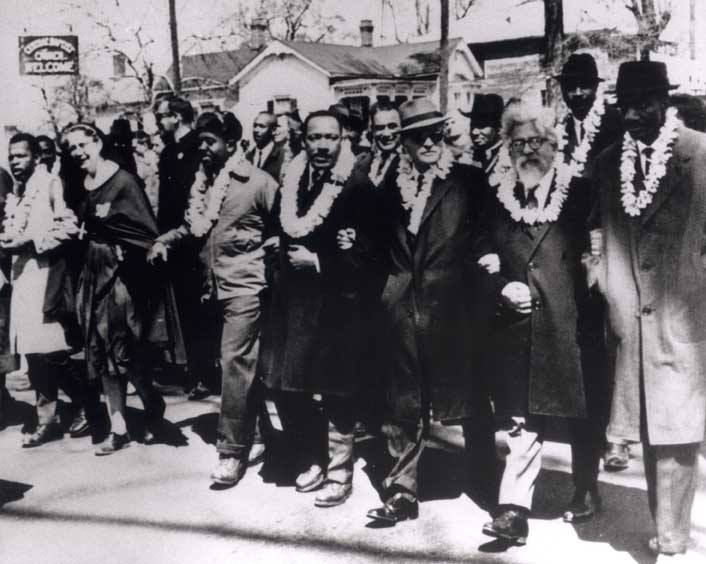
Rabbi Abraham Joshua Heschel

Heschel and King
Rabbi Heschel is one my favorite authors. The picture above shows the white haired Heschel at Selma with Martin Luther King Jr, John Lewis, Ralph Abernathy, and Ralph Bunche (reprinted from Susannah Heschel’s collection on the Dartmouth College website). One of the dozen or so quotes on my favorite quotations page is from the rabbi who was an activist a generation ago although the quote relates to religious ritual, symbol and myth rather than activism … “all conception is symbolization,” sayeth the rabbi.

I mention him here because of a blogpost regarding the Missouri legislature naming a highway after the rabbi in response to a hate group adopting the highway. See the National Democratic Jewish Council’s blog for details.

WAY TO GO MISSOURI!!

Book Review: The First Paul by Borg and Crossan (Part 3)

In part 1, I introduced co-authors Borg and Crossan, and in part 2, I discussed their majority view treatment of authentic Pauline letters vs pseudo-Pauline writings that came later as “correctives” to the radical Paul, in the authors’ view. Today, in part 3, I will discuss their less orthodox view that the Roman Emperor and the Empire were Paul’s veiled enemies in his writings, and this discussion will include links to a number of discussions of this issue.

Borg and Crossan are first and foremost Jesus scholars who offer a low christology that is less divine and more human, less other-worldly than here and now, more about a social reformer than an end-times avenger. Whether one agrees or disagrees is not relevant to this book, but what is important to note is their attempt to have Paul fit the same mold. This is where they part company with their scholarly peers.

Read more …