Author Archives: Obie Holmen

Just what is the Bible and how do we use it?

A recent post by Doug Kings  has stirred things up at the  BOFI (Book of Faith Initiative).  BOFI  is an ELCA effort at energizing Bible study, but Kings, a Chicago pastor, is skeptical.

The church does indeed have a Bible problem but it’s not people’s ignorance about it. The question is whether the church can let the Bible be what it is: the collected thoughts of a particular ancient people, containing their prejudices and ignorance but also some genuinely profound insight into living with God and with one another in our paradoxical world of beauty and pain, purpose and confusion.

The sexuality task force, with commendable candor, admitted the ELCA lacks a basic consensus on how to read the Bible. Without such a consensus, we will continue to flail about, squabbling among ourselves, uncertain of our mission. How the Bible should be read today is not obvious.

As one who has taught adult Bible education in my own parish for a number of years, I share Kings’ critique of the church’s ambivalent attitude towards the institution of scripture.  Kings suggests the ELCA seminaries teach the historical critical method, but whisper on the way out, but don’t tell anyone.  The “Word of God” is understood as the “words of God” without correction.

I belong to a men’s group at my present parish consisting of retired, mostly professional men with long histories in the church.  Nearly a quarter are retired clergy.  Yet, I bite my tongue at the misconceptions: John the apostle was the same person as John the evangelist; the same for Matthew; 2nd Peter’s comment about the transfiguration proves that it was a historical event (after all, Peter was there!); the consistency of the synoptics proves their truth.  And these all just at yesterday’s meeting!

Yet, I challenge only selectively.

Wellhausen, the 19th century scholar most associated with the Documentary Hypothesis (JEPD) and the historical critical method, supposedly stopped teaching it near the end of his career because it didn’t lift up the faith of his students but actually detracted from it.  He didn’t reject the accuracy of the approach but the utility of it.  So too is the church’s ambivalence and my silence in the face of the misconceptions of my men’s group. 

Kings suggests that we simply need to be honest about what the Bible is and especially what it is not:

Modern scholarship has actually discovered a great deal about the Bible but much of it is ignored because it doesn’t tell us what we want to hear. Modern biblical study’s totally unsurprising conclusion is that the Bible is theology, through and through. Thus, it isn’t history, biology, geology, astronomy, economics, political science, psychology or any of the other contemporary subjects which so fascinate us and about which we have so many questions. For answers to them, we must look elsewhere.

He is right, of course, but the difficulty lies in challenging inbred assumptions without seeming to question faith.

Is my marriage gay?

An Op-ed in today’s NY Times comes from Jennifer Finney Boylan.

Boylan was male when he entered into a heterosexual marriage in 1988 but has since become legally female, at least in her home state of Maine. The marriage continues: “Deedie stood by me, deciding that her life was better with me than without me … the things that she loved in me have mostly remained the same, and that our marriage, in the end, is about a lot more than what genders we are, or were.”

Her op-ed piece offers a fresh perspective on the issue of gay marriage and the silliness of attempting to define marriage according to gender or even attempting to define gender itself. “How do we define legal gender? By chromosomes? By genitalia? By spirit? By whether one asks directions when lost?”

Elizabeth Kaeton comments on the article in her blog, Telling Secrets. Kaeton says she confronts her own sexism and internalized homophobia and that “transsexuals, as a group, continue to be maligned among some LGBT people as well as the heterosexual community. They make us uncomfortable. They challenge us to change traditional understandings of gender, relationships, why, even marriage!”

Both the original Op-ed piece and Kaeton’s blog post are worth reading.

ELCA Book of Faith Initiative Embraces Online Social Network


CHICAGO (ELCA) — Members of the Evangelical Lutheran
Church in America (ELCA) are reading and discussing the Bible
as part of the church’s Book of Faith initiative. That
discussion is being propelled with Internet technology.

An estimated 2,400 members have signed on to the Book of
Faith social network — http://bookoffaith.ning.com/ — made
possible through Ning, an online platform for users to create
their own social networks.

“Ning is really very similar to Facebook,” said Bill Huff,
assistant director for the Book of Faith initiative, ELCA
Vocation and Education, St. Paul, Minn.

“Social networking is one of the fastest growing vehicles
for personal communication right now,” Huff said. “The essence
of Book of Faith is that it’s not a program. We don’t want it
to be a top-down initiative,” he said.

“The motivation for a social networking site is to stay
in contact with individuals and to be in contact with large
groups of people who have similar interests,” Huff said. “You’ll
be able to socialize with your colleagues throughout the country,
but also you’ll be able to share ideas and be able to see what
other people are doing.”

“The Book of Faith tag line is ‘Open Scripture. Join the
Conversation.’ So much of what the Ning site is about is joining
the conversation,” Huff said. “Once you’re signed up you have a
profile, and you can tell a little bit about yourself. Then you
can join the conversation.”

Someone reading the Bible can find study helps as well as
others who may be reading on their own. There are more than 45
videos and other resources on the site. There is an area of the
site to find or add events.

Augsburg Fortress, the publishing ministry of the ELCA,
Minneapolis, established the Book of Faith’s Ning site.

The initiative is generating resources in congregations
across the church, and the Ning site is a means for sharing
“what’s working in my setting,” Huff said.

“If you are a Sunday school volunteer, you can go on to
the conversation piece and see what’s going on with people as
they teach their kids,” he said. “People post ideas, but also
people post questions or theological concerns.”

“The goal is to get people engaging in Scripture, so
anything we can do to help that along is meeting the mission
and will help the ELCA,” Huff said.

Reform Movement Renews Call to Repeal “Don’t Ask Don’t Tell,” Supports Reinstatement of Arabic Translator


WASHINGTON, D.C., May 8, 2009 – In response to Lt. Dan Choi’s recent discharge from the Army National Guard under the “Don’t Ask, Don’t Tell” policy, Rabbi David Saperstein, Director of the Religious Action Center of Reform Judaism, released the following statement:

The U.S. Army this week discharged Lt. Dan Choi, the military’s top Arabic linguist, after Choi revealed in March that he is gay. The military’s decision to fire Lt. Choi for his sexual orientation is yet another disappointing example of just how misguided the Don’t Ask, Don’t Tell policy is. With our military stretched and strained by the wars in Iraq and Afghanistan, the dismissal of crucial and qualified personnel solely because of their sexual orientation is not only unjust and a violation of the American promise of equal rights and opportunity for all — it is also a threat to the safety of our nation.

President Obama has indicated that he recognizes the injustice of Don’t Ask, Don’t Tell. We urge him to address this critical issue of national security and civil rights by making repeal of the policy a priority. He can – and should – begin by reinstating Lt. Choi.

Muslim integration in the West


Here are two articles about Muslim integration into western society. The first is from my local newspaper, the Mpls Star Tribune, and features Augsburg, an ELCA college in Mpls. The second is a Reuters release about attitudes revealed in polling in the western democracies of Europe that suggests Muslims are less integrated in Europe than in America.

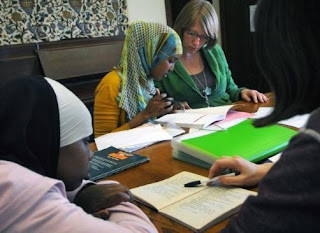
Not so long ago, Fadli Mohamed would not have fit the mold of typical Augsburg College students: She’s no white Lutheran kid from the suburbs.

But change has come rapidly to the small, 140-year-old Lutheran college that shares its Minneapolis Cedar-Riverside neighborhood with the highest concentration of Somali people in the United States.

For years Augsburg has reached out to its immigrant Muslim neighbors, helping to care for their infants, tutor their high school students and feed their elderly as part of the college’s service learning program.

Now children from those Somali families, people like Mohamed, are increasingly enrolling at Augsburg, rising from a handful three years ago to more than 30 this year. It’s still a small fraction of the 1,900 daytime undergraduates, but they’re a notable presence among those lending a hand to the neighborhood.

“It gives a different face to the college’s volunteerism and service,” said Mohamed Sallam, director of the college’s Pan-Afrikan Center. “These are students who may or may not come from this neighborhood but feel connected to it through ethnic and religious identity. They are products of the community and they’re giving back in such a way where members of the community can feel very proud.”

Students volunteer in the neighborhood, but they study there, too. A journalism class interviewed people from different backgrounds to create a cookbook called “The Taste of Cedar-Riverside.”

Mary Laurel True, associate director for the college’s Center for Service, Work and Learning, said the program is not an add-on. “The whole idea of service learning is that it’s integrated into the classroom, into everything we do.”

Augsburg undergraduates are required to take two religion courses, and in studying Islam, they hear about the faith from people who practice it, often visiting one of the four mosques within blocks of the school.

“Here we are, this Lutheran institution, and yet we have this rare gift to experience — not just read about, but experience — other people’s faith,” said Paul Pribbenow, the college’s president since 2006.

After being greeted by imams at the mosque, students take off their shoes, enter and observe people praying, said assistant Prof. Jeremy Myers. His introductory religion course is called “Christian Vocation and the Search for Meaning,” but he’s hoping to add “in Cedar-Riverside” to its title.

There, students “experience hospitality,” Myers said. “Especially in the last eight years — and even within the last few months — it’s important that they learn what Islam is and what it’s not. It’s important that people see the truth or a different side of the truth.”

Embracing the city

Augsburg College was founded as a Lutheran seminary in rural Wisconsin in 1869 and relocated three years later to Minneapolis. Early in the 20th century, the school “embraced the community and saw Minneapolis as a place of opportunity and service,” a chapter on Augsburg in a 1998 book titled “Successful Service-Learning Programs” recounts.

However, the school also has a long history of “organized efforts … to move to the suburbs for ‘more room and fresh air … more desirable locations,'” according to the text.

That tension occasionally resurfaced over time.

“If you go back even 10 years ago and look at some of Augsburg’s admissions materials, they often talked about this college as an oasis in the city,” Pribbenow said. “And I think what has shifted is that now we’re saying, we are no oasis. This is it. This is the city. We are the city.”

The makeup of the college’s incoming class has changed substantially since 2005:

Then, students of color made up 10.7 percent of the incoming class; last fall it was 17.9 percent. In 2005, the college tended to attract students from the suburbs; in 2008, the greatest number of incoming students came from Minneapolis high schools Henry and Roosevelt. The number of students who list their religion as Lutheran has dropped over that time, while the number of those who listed a religion other than Lutheran or Catholic has grown.

The appeal of Augsburg

Somali students come to Augsburg for the same reasons as any other students: Small classes, an urban setting, a focus on community service.

As a high school senior, Fadli Mohamed had her college choices ranked, with Augsburg in second place. Then she happened to meet Augsburg students who were tutoring her neighbors in English.

“They were so friendly,” said Mohamed, now 19. “Seeing people from the school doing something positive where you live — it made a huge difference.”

The number of Somali and Muslim student groups and services has grown along with the students. There’s the Pan-Afrikan center and student union — which brings together African and African-American students — as well as the newly-founded Muslim Student Association.

One of the students who helped start that group, Ahmednur Ali, was shot to death last fall on his first day volunteering at the Brian Coyle Community Center in Cedar-Riverside. The 16-year-old charged in his death reportedly shot him because Ali wouldn’t let him play basketball. Ali was the first Augsburg student to be fatally shot in the college’s history. In some ways, his passing brought the Augsburg and Somali communities closer, several students and leaders said.

People with the college talk about how Sallam and other Muslims helped fashion Ali’s memorial service so that it was reflective of Islamic traditions.

People with Somali organizations talk about how, despite some trepidation, students continued to volunteer. About how President Pribbenow was ever-present during that time.

“He came and said condolences to the father and the family,” said Saeed Fahia, executive director of the Confederation of Somali Community in Minnesota. “That’s significant. That shows the kind of neighbors they are.”

By Jenna Ross in the Mpls Star Tribune

Here is the Reuters article reprinted from MSNBC.com.

LONDON – Muslims living in European countries feel far more isolated than those living in the United States, according to a survey on coexistence, with a lack of access to education and jobs reinforcing a sense of ostracism.

At the same time, Muslims in France, Britain and Germany feel far more loyalty to their country than they are perceived to feel, and express a strong willingness to integrate.

The findings by pollsters Gallup tend to suggest that a longer period of migration to the United States and economic growth there has helped foster integration. Meanwhile, Muslims in Europe are working hard to fit in and say it is important, but they are not always seen to be succeeding.

“This research shows that many of the assumptions about Muslims and integration are wide of the mark,” said Dalia Mogahed, the executive director of the Gallup Center for Muslim Studies and co-author of a report based on the findings.

“European Muslims want to be part of the wider community and contribute even more to society.”

The survey, described as the first of its kind, polled at least 500 Muslims in June and July of last year to generate its findings on European Muslim integration. At least 1,000 members of the general public in each country were also randomly surveyed to create comparisons on specific issues.

While 38 percent of Muslims in Germany, 35 percent of those in the United Kingdom and 29 percent of those in France were found to be “isolated” in their countries, that figure stood at just 15 percent in the United States and 20 percent in Canada.

“This can be explained by the historical importance of immigration in the development of Canada and the United States as modern nations,” said Mogahed, adding that better access to higher education and work in North America had helped over decades to create more integration and social advancement.

‘Perception gap’
One of the starkest findings of the surveys was the gap in perception between European Muslims and the general public.

While nearly half of French Muslims (46 percent) said they felt integrated, only 22 percent of the French public said they felt the same about the Muslims living in their country.

In Germany, 35 percent of Muslims saw themselves as integrated, but the broader public put it at 13 percent. And in Britain, while 20 percent of the public thought Muslims were integrated, only 10 percent of Muslims thought they were.

Mogahed and co-author Mohamed Younis said the findings showed how hard it was to draw broad conclusions about Muslim integration across Europe or develop policy as a result.

They suggested that country of origin — many Muslims in France are originally from North Africa, many in Germany are originally from Turkey, and in Britain from Pakistan or Bangladesh — affected integration and/or its perception.

That certainly appears to be the case when the surveys examined the importance of certain moral issues to Muslims and compared it to the general public in each country.

In France, 78 percent of the public said homosexual acts were “morally acceptable,” while 35 percent of Muslims agreed. In Germany, the ratio was 68 percent of the public and 19 percent of Muslims. In Britain, it was 58 percent to zero. The margin of error was five percentage points in all cases.

Similar dissonance was found on issues such as viewing pornography, extramarital sex, suicide and the death penalty.

The authors suggested that a combination of more rigid views and religious practices by Muslims in certain countries had contributed to a misperception about their degree of integration, even while those Muslims were keen to integrate.

“Since 9/11 and the terrorist attacks in Madrid and London, mistrust toward European Muslims has become palpable,” the authors wrote. “Significant segments of European societies openly express doubt that Muslim fellow nationals are loyal citizens.

“The integration debate has to widen its frame, moving beyond the confines of security and religion, and focus more on the socioeconomic struggles of citizens of all faiths.”

Young Americans Losing Their Religion


By Dan Harris on abcnews.go.com

New research shows young Americans are dramatically less likely to go to church — or to participate in any form of organized religion — than their parents and grandparents.

“It’s a huge change,” says Harvard University professor Robert Putnam, who conducted the research.

Historically, the percentage of Americans who said they had no religious affiliation (pollsters refer to this group as the “nones”) has been very small — hovering between 5 percent and 10 percent. However, Putnam says the percentage of “nones” has now skyrocketed to between 30 percent and 40 percent among younger Americans.

Putnam calls this a “stunning development.” He gave reporters a first glimpse of his data Tuesday at a conference on religion organized by the Pew Forum on Faith in Public Life.

The research will be included in a forthcoming book, called “American Grace.”

This trend started in the 1990s and continues through today. It includes people in both Generation X and Y.

While these young “nones” may not belong to a church, they are not necessarily atheists.

“Many of them are people who would otherwise be in church,” Putnam said. “They have the same attitidues and values as people who are in church, but they grew up in a period in which being religious meant being politically conservative, especially on social issues.”

Putnam says that in the past two decades, many young people began to view organized religion as a source of “intolerance and rigidity and doctrinaire political views,” and therefore stopped going to church.

This movement away from organized religion, says Putnam, may have enormous consequences for American culture and politics for years to come.

“That is the future of America,” he says. “Their views and their habits religiously are going to persist and have a huge effect on the future.”

This data is likely to reinvigorate an already heated debate about whether America is, or will continue to be, a “Christian nation.” A recent Newsweek cover article, entitled “The End of Christian America” provoked responses from religious thinkers all over the spectrum.

Putnam, author of the book “Bowling Alone,” which tracked the decline in civic and community engagement in America (exemplified by the diminution of bowling leagues), fears the reduction in religiosity could have widespread negative impacts.

His research shows that people who go to church are much more likely to vote, volunteer and give to charity.

However, he says, it’s possible that the current spike in young people opting out of organized religion could also prove to be an opportunity for some.

“America historically has been a very inventive and even entrepreneurial place in terms of religion,” he says. “We’re all the time inventing new religions and reinventing religions that we have. It’s partly because we have a free market in religion. That is, we don’t have a state church.”

Given that today’s young “nones” probably would be in church if they didn’t associate religion with far-right political views, he says, new faith groups may evolve to serve them.

“Jesus said, ‘Be fishers of men,'” says Putnam, “and there’s this pool with a lot of fish in it and no fishermen right now.”

In the end, he says, this “stunning” trend of young people becoming less religious could lead to America’s next great burst of religious innovation.

Maine Legalizes Same-Sex Marriage: The Groundswell Grows


From NPR.org, May 6, 2009

Maine’s governor signed a freshly passed bill Wednesday approving gay marriage, making it the fifth state to approve the practice and moving New England closer to allowing it throughout the region.

New Hampshire legislators were also poised to send a gay marriage bill to their governor, who hasn’t indicated whether he’ll sign it. If he does, Rhode Island would be the region’s sole holdout.

The Maine Senate voted 21-13, with one absent, for a bill that authorizes marriage between any two people rather than between one man and one woman, as state law currently allows. The House had passed the bill Tuesday.

Democratic Gov. John Baldacci, who hadn’t previously indicated how he would handle the bill, signed it shortly afterward. In the past, he said he opposed gay marriage but supported civil unions, which provide many benefits of marriage.

Debate was brief. Senate President Elizabeth Mitchell, D-Vassalboro, turned the gavel over to an openly gay member, Sen. Lawrence Bliss, D-South Portland, to preside over the final vote.

Republican Sen. Debra Plowman of Hampden argued that the bill was being passed “at the expense of the people of faith.”

“You are making a decision that is not well-founded,” warned Plowman.

But Senate Majority Leader Philip Bartlett II said the bill does not compel religious institutions to recognize gay marriage. “We respect religious liberties. … This is long overdue,” said Bartlett, D-Gorham.

Maine is now the fourth state in New England to allow same-sex marriages. Connecticut enacted a bill after being ordered to allow gay marriages by the courts, and Vermont passed a bill over the governor’s veto.

New Hampshire’s House was also expected to vote on a bill Wednesday and send it to Gov. John Lynch, a Democrat.

Massachusetts’ high court has ordered the state to recognize gay marriages. In Rhode Island, a bill to legalize same-sex marriage has been introduced but is not expected to pass this year.

Outside New England, Iowa is recognizing gay marriages on court orders. The practice was briefly legal in California before voters banned it.