Tag Archives: ELCA

Wounded Healer: LGBT faith story number one

 Booklet cover

As reported earlier, the two Minnesota metro synods of the ELCA have a joint inclusivity committee, and the committee’s website offers a booklet for download entitled Listen to Their Hope: Hear Their Faith.  The author of the booklet, Kari Aanestad, is an Augsburg College graduate and currently preparing for the ministry at Luther Seminary in St Paul.  Kari has compiled ten stories that:

portray the joy, the pain, the struggle of loving, committed individuals who love their church, but do not always feel welcomed or affirmed in who they are. We believe that God loves every person and that each person bears the image of God. Their stories are signs that the Spirit has been working in our midst, often undetected.

One story a day will be published here as we march toward the historic church wide assembly of the ELCA to take place in Minneapolis beginning August 17th.  Here is story number one about Glen, a Wounded Healer.

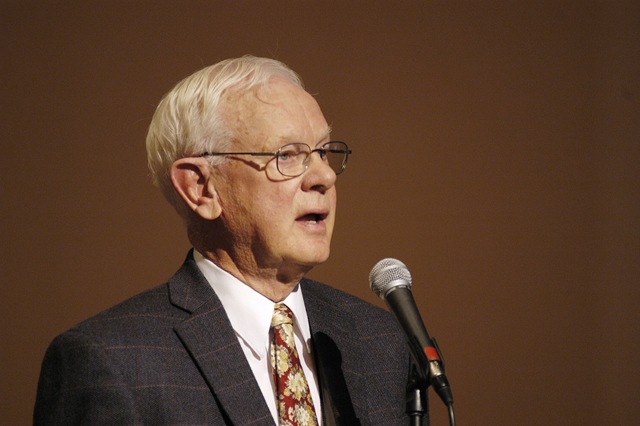
Standing at nearly 6’5”, Glen Wheeler is a gentle giant, but not simply because of his height. As an ordained Lutheran pastor for more than forty years, Glen continues to lead publicly even in retirement. As we walk toward an empty room on campus at Luther Seminary for our interview, he knows and greets nearly every person we pass. They respond to him with warmth and, having seen him, seem happier. We find our room and begin talking.

“I grew up in the oil fields of northwestern Montana,” Glen said. “My family had homesteaded in the Valier/Birch Creek area in 1912 after arriving from Canada in a covered wagon. The first nine years of my life I lived out in the oil field in very sub-standard housing.”

“When I was seven, the Presbyterians picked me up in a school bus and took a few of us to Vacation Bible School held on the dance floor of the Santa Rita Tavern. They also took me to Bible camp at Lake Five near Kalispell, Montana. Growing up, I didn’t have any consistent experience with church or Bible school. I liked a girl that I followed to Sunday school every now and then, but nothing consistent.

Glen’s family didn’t belong to a church. His grandfather felt the Bible advocated slavery. So Glen’s grandfather remained an agnostic throughout his life.

“My sister, who was ten years older than me, became a Christian during military service. She always wanted us to say grace before a meal or go to church on Sundays, but we always went trout fishing instead. Trout fishing was my first religion.”

When Glen reached high school, however, he became anxious about his own salvation. He started to become curious about religion and wanted to explore his own faith. At this same time he noticed his friends were involved with alcohol abuse and sexual promiscuity. In response to his peers, he had to decide who he was and if he was going to join in destructive habits.

“I decided I wasn’t going to, but I needed some reasons not to.”

He began reading scripture to look for moral guidance, but instead he found much more: a calling to Christian faith and ordained ministry. “I read Romans 10, where it says, ‘If you confess with your lips that Jesus is Lord and believe in your heart Christ was raised from the dead, you shall be saved.’

That scripture captured me. So there I was: a believing Christian who had no faith community.”

He was not going to be without a community for very long.

“When I was a senior in high school, I took a speech class. I looked at all of my classmates and friends who were having moral struggles. I decided to give a speech on the value of reading the Bible and almost chickened out. After I gave the speech, two Lutheran boys, whom I had previously teased for wearing white dresses to light the candles at church, told their pastor about my speech, and they invited me to a Valentine’s party at the church. That was my first entry into Christian worship. I started going to worship that spring.”

Glen went to Concordia College in the fall and was baptized at Christmas time of that year.

“I had officially made it into the Lutheran church five days before I became 18 years old.”

Throughout college he continued to develop his faith and explore his call to ministry. As an outsider to the Lutheran faith, Glen entered seminary with an open mind. During his first two years he took a course on urban ministry, which inspired him to serve in an urban setting for his internship. The academic year of 1964–65, Glen interned at a church in Detroit, Michigan. At the height of the civil rights movement, Glen found himself in a church primarily composed of young, gang-affiliated black teenagers and their families. He had quite an internship experience.

“One Sunday the senior pastor left to take part in the civil rights march in Selma, Alabama. He left for the march and told me I had to stay home and take care of the congregation.”

There was certainly a lot to take care of. To compound the intensity of the church’s urban setting during a social movement, Glen became aware that his prophetic senior pastor was a gay man. There were also young adults in the congregation who were beginning to understand themselves as gay.

“We had a bright teenager in our congregation who was very close to his mom, and the kids teased him about it. He was beginning to understand himself as a gay man. He eventually went to the Juilliard School of Music and is serving the church today as a wonderful church musician. But in watching this man and others struggling with similar issues I began to realize that ministry happens not when you think about what people ‘should be’ or ‘ought to be,’ but when people are ‘who they really are.’”

After internship and the completion of seminary, Glen was ordained and called to urban ministry in Milwaukee for 8 years. Then, following a year with the Ecumenical Institute in Newark, New Jersey, Glen was called to a congregation in Iowa, where he served for almost 20 years.

“Four years into that call, I became a divorced Lutheran pastor and a single parent of three little kids. When my wife left that marriage, I soon discovered that if I was going to continue in that ministry, the only thing I had going for me was the grace of God. I didn’t see any other reason to be there as their pastor or to continue in ministry. For four years, I had served the congregation as a teacher of theology through adult education, and my approach to theology was pretty cerebral. As soon as I became a divorced pastor, I began to see that the congregation wanted a wounded-healer ministry from me. They were also wounded. They saw me as someone more approachable now, someone different than the theologian, preacher, or teacher. That was one of the beginnings of change for me in the focus of my ministry. Three years after the divorce, I remarried, and my wife and I raised six teenagers together.”

Later in that same period, the Lutheran church was faced with a dilemma of how it should respond to people who were diagnosed with HIV/AIDS. Glen received his answer.

“I can still remember where I was driving on a road in Iowa when I heard on the radio Mother Teresa’s response to the question, ‘How should the church respond to victims of HIV/AIDS? ’ She just said, ‘The people who are dying need to know the unconditional love of God and that we love them also.’ She was so clear about the church’s role — at a time when many of us were still trying to figure that out.”

Glen discovered that his ministry had taken the focus of helping others learn of God’s unconditional love and also encouraging others to love one another unconditionally. Soon after he’d heard Mother Teresa’s words, his Iowa congregation chose to celebrate the lives of two members who lost their lives to AIDS.

“It was a hard time for our church, but it was good to see us begin to make the transition to celebrating the lives of all of our members.”

Glen’s challenge to help others know the unconditional love of God continued. In 1994 Glen took a call to a Minneapolis church as a solo pastor. He quickly felt overwhelmed. The church decided to provide a part-time visitation pastor to help serve the seniors.

“After interviewing multiple candidates, we found someone whom we thought was the perfect candidate. At the end of this pastor’s interview, however, the candidate said, ‘Oh, by the way, I’m gay. Is that a problem?’”

Glen said he didn’t believe it was a problem, but he needed to consult the Administrative Board. They were not ‘calling’ a pastor, but were offering a contract for a part-time position. All of the Administrative Board agreed that having a gay pastor was not a problem, but they couldn’t offer the contract yet because one member was absent. When Glen contacted that board member and told him about the situation, his response was, “It’s not a problem to me.” The pastor was offered a contract and was later extended a call as part of the ministry team, where he served for nine years until his retirement.

“We later learned that this final board member and his wife had a daughter who was in a same-gender committed relationship and was expecting twins. Fortunately, our congregation had completed the process of becoming a Reconciling in Christ (RIC) congregation before the twins were born. The board member and his wife, who was the president of the congregation, were able to share with the other elected leaders the joy of becoming grandparents,” Glen said. “It was interesting that all of us took the risk of calling a pastor who is gay without knowing how others would react or who might be in each other’s families. It demonstrates that we don’t know who is sitting in our congregations — who has gay family members or not.”

Glen started as an outsider to the Christian faith and community and has become a powerful advocate for Lutheran congregations to become Reconciling in Christ congregations. His ministry, which first focused on racial social justice, has now led him to be an advocate for welcoming gay, lesbian, bisexual, and transgendered people and their families to our communion tables as members of the Body of Christ.

“Our identity in Christ comes to us through the gift of our baptism and not through our gender identity or sexual orientation. Young gay and lesbian Christians in my congregation in Iowa took the risk of trusting me as their pastor when they began to come out of the closet. The trust of those young Christians coming out to their families, to their church, and to me has motivated me to do all I can to make sure they will be welcomed as members of the Body of Christ. The promises we made to them in baptism require it.”

“I don’t think I chose this role — I think it came to me through ministry. Once you get past the moralism that leads to people feeling like ‘I should feel this way’ or ‘Other people shouldn’t do this’ — once you get past the ‘shouldas’ and ‘oughtas’ — then I think the grace of God has a chance to enter in and transform us and take over.

“Christ is present here in our lives and in our ministry, and the only thing any of us has is the unconditional grace of God. If we think we’ve got something different or that some are bigger sinners than others, then we’ve got theological baloney.”
Listen to the stories of gay Christians

Are there gay persons in your church?  Do you know who they are?  Do you know their stories?

There are 65 regional synods of the Evangelical Lutheran Church in America (ELCA), 5 in Minnesota alone, including one each for Minneapolis and St Paul.  These two metro synods have formed a joint committee on inclusivity with a website and a booklet entitled Listen to Their Hope: Hear Their Faith.

It is with a spirit of hope and gratitude that the Inclusivity Committee offers this
booklet to all members and clergy of the ELCA. The stories presented in this booklet represent the journeys of LGBT folk, their parents, and non-gay persons, all members of the two Twin Cities synods that our committee serves. They represent a much larger collection of narratives that one can find in every congregation, many of which have never been told. We share these stories with you as evidence of what might be called “realized ecclesiology”, the future already happening through a God who draws us into the future — a God that invites us to pursue our hopes rather than our fears.

The 49 page booklet may be downloaded in PDF format from the website.  There is a foreword from Bishop Craig Johnson of the Minneapolis area synod and a preface by Bishop Peter Rogness of the St Paul area synod.  The booklet invites us to forget the politics of gay marriage and gay clergy for a moment and just listen to personal faith stories.

“It is always of utmost importance for us to hear the stories of the Baptized that live among us and have also suffered among us.”

(from Foreword by Bishop Craig Johnson, Minneapolis Area Synod, ELCA)

In this book, you will be immersed in this invitation to step back from the hysteria and the debate and meet some people. Hear their stories. Understand their journey. Listen to their hopes and struggles and values — and, in the midst of it all, hear their faith.

Throughout history the people of God have been at our finest when we, like Jesus, have been caring for the hurts of the world. We have been at our worst when we have mounted platforms of self-righteousness and made judgmental pronouncements that, ultimately, are best left to God and humble human reflection.”

(from Preface by Bishop Peter Rogness, Saint Paul Area Synod, ELCA)

There are ten stories in the booklet, and I will publish one a day for the next ten days. Sign up for an RSS feed if you want them to download automatically into your feed reader.

ELCA Church wide Assembly: pre-convention lobbying #CWA09


On August 17, the ELCA will meet in biennial assembly in Minneapolis.  In a previous post, a pre-assembly primer, I mentioned the conservative group, WordAlone, and its opposition to the gay marriage and gay clergy proposals that will be considered by the assembly.  WordAlone laments a perceived “theological drift” in the ELCA and offers judgmental accusations in a speech printed on its website:

[T]he ELCA has drifted further and further away from her great Lutheran heritage, to the point that some things being taught and done within our denomination are difficult to recognize as fully Christian, much less solidly Lutheran.

It’s not enough to say “I disagree”; no, it’s better to challenge the Christian heart of others.   Heretics we are, it seems, if we don’t teach and do as they would have us.

WordAlone’s fellow travelers, the COALITION FOR REFORM, Lutheran CORE, promotes the same agenda but seeks  to avoid the possible stigmatizing effects of WordAlone’s conservative history and reputation.  From the “about us” page of CORE’s website:

Lutheran CORE is closely allied with the WordAlone Network for mutual support. However, Lutheran CORE is a broad based coalition and is open to those individuals and congregations who do not choose to affiliate with the WordAlone Network.

Lutheran CORE claims to be the “vast middle” of American Lutheranism, “the solid, faithful core that is the majority” (mindful of Nixon’s silent majority or Jerry Falwell’s moral majority).  Moderate reformers they are not, despite their attempt to claim middle ground.  Their reform is a retrenchment behind conservative pillars.  According to their website, at the top of their list of concerns is the affirmation of “the authority of the Word of God” and “our profound concern over changes in doctrine and practice regarding marriage and sexuality.”  Their website offers a critique of the use of reason in moral deliberations.  In apparent opposition to the ELCA’s  fifty days of prayer initiative, CORE offers its own forty day program.

Their website contains an open letter to assembly delegates that not only opposes the sexuality statement but questions … “if indeed the assembly should be voting on these matters at all.”  Harrumph!  As protectors of the purity of the pulpit and the morality of the marriage bed, theirs is truly a higher calling.

In his characteristic understated manner, the original presiding Bishop of the ELCA, Herbert Chilstrom, has taken CORE to task.  Rev Chilstrom now resides in retirement in St. Peter, Minnesota, and he has penned a letter to assembly delegates in which he rebuts the open letter of CORE, point by point.

First, “I find major problems with the CORE Letter when it speaks about the Word of God,” Chilstrom writes.   “At best, this section is confusing; at worst, misleading.”  Chilstrom points to the recent history of the church allowing the ordination of women despite certain negative Biblical texts and despite long standing church tradition.  “We believed there were deeper streams in the Holy Scriptures that we needed to listen to,” Chilstrom writes about the experience of ordaining women. 

Deeper streams in the Holy Scriptures: the essence of a sophisticated understanding of “The Word of God” and of Luther’s notion of “the canon within the canon.”  Proof texting not allowed.  Questioning the authority of culturally conditioned texts is not rejection of the Word of God.

Second, Chilstrom supports a decision by a majority vote and rejects Core’s call for a supra-majority.  “And why does 2/3 plus one make us more certain the Holy Spirit is guiding us?”  Why not 90%?  Will the naysayers be convinced by any margin?

Third, Chilstrom scoffs at the notion that the assembly risks ecumenical relationships with Roman Catholic, Orthodox, and Evangelical Christians, again citing the experience of ordaining women. 

Do you not realize that [ordaining women] was the first nail in the coffin of further ecumenical progress with certain churches? Do you therefore regret our decision to ordain women? Would you support revisiting that decision in order to foster better ties with the Roman Catholic and Orthodox churches? 

In his bluntest statement, Chilstrom asks, “How long are we going to live with the illusion that Vatican II is alive and well in Roman Catholicism?”

Fourth, the fear of a double roster, one gay and one straight, is bogus, Chilstrom suggests.  The church has always understood that local parishes have the final say on calling their pastor, and he jokes that there was a time when “just being a Norwegian or a Swede put one into a separate category! Yet, in spite of those multiple ‘lists’ we never forced a congregation to call someone it did not vote to call.”

Fifth and lastly, Chilstrom acknowledges the shrinking membership of mainline denominations but argues that allowing gay clergy will not aggravate the problem; instead, he suggests “a reformation that focuses on the offense of the Gospel of the crucifixion and resurrection and advocates unapologetically for justice for the poor and the disenfranchised.”

Chilstrom at '05 bienniel When the ELCA came into being in 1987 as the result of merger, Bishop Chilstrom was the church’s first pastor, the first shepherd of a flock of some five million.  Thank God for his pastoral leadership then and now.  He concludes his letter:

And that’s why I strongly favor the Statement on Sexuality and the Recommendation coming to the Assembly.  I pray for its passage. I pray it will be a strong message to the world that we are a church that includes rather than excludes those who love our Jesus as intensely as I do – and as you do. Yes, and a church that welcomes as pastors those whose only difference is that they are gay or lesbian and long for a faithful relationship. Binding us together is the sure and certain promise that it is the Holy Spirit who calls, gathers, enlightens and sanctifies the church. We can move through these next weeks with that assurance.

New Orleans Resident Thanks ELCA Youth

I received a lengthy comment to an earlier post about the New Orleans ELCA youth gathering.  I reprint the words of doctorj2u here.

I cannot tell you how much I appreciate the ELCA for holding their youth gathering in New Orleans. The biggest hurt to me from the storm was the sense of abandonment by a country I had loved with my whole heart. Unbelievable massive unending devastation, a populace doing its best to survive on an individual, family and community level.

Slowly small groups of volunteers began to appear. Groups of 10, 15 and twenty. Coming to help on their own dime out of the goodness of their heart and their outrage of injustice. But for every volunteer there was an American telling us we deserved the horror of Katrina, that we were stupid to live in our 300 year old city that had parts below sea level, that we were not “really” American.

It was April 2008 when I realized New Orleans would survive. Ever since then, though slow, the progress has been steady. And when I read that the ELCA was bringing 37,000 (!!!) to come and help the city I thought to myself THIS is what I was waiting for. THIS is what I thought would happen after Katrina and the levee breaks.

One speaker of your group said if one person worked 4 hours a day, 365 days a year, it would take him over 900 years to accomplish what your group did in a weekend. That is an AMAZING thought and you should be so proud of yourself, your volunteers and your church. 4 years after Katrina we are now at the halfway point to total recovery. The ELCA is part of that and I cannot thank you enough. It was a very good weekend for New Orleans. We are not forgotten.

THANK YOU!!!

ELCA Youth Gathering: the journey to New Orleans

Keith Pearson is the pastor of First Lutheran of Hector, Minnesota … and my brother in law.  He just got back from the ELCA youth gathering in New Orleans, along with a handful of youth from his own parish.  They were part of a larger group of several dozen from the area who journeyed together.  Pastor Keith has consented to a reprint of his five days of blogs, his own first person account.  Check out Keith’s blog, which contains a ton of pictures.

Day One

Wednesday, July 22, 2009

Much  of our first day was simply about getting there. We had some last minute schedule changes, some delays, and one lost bag, but in the end we arrived here safe and sound.

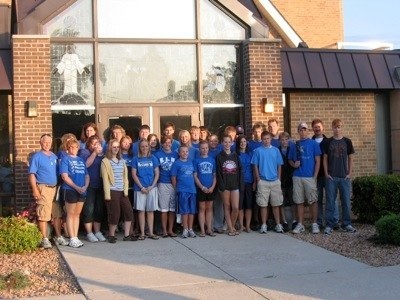
Keith's group Once on the ground in New Orleans we checked in to our hotel and then headed to the New Orleans Convention Center where our activities began. At supper time we managed to sample a little taste of New Orleans at “The Crazy Lobster,” a restaurant right on the edge of the Mighty Mississippi. Some were bold in their food orders, others stuck to burgers and fries. We even had a little live New Orleans Jazz music to accompany our meal.

It was pretty exciting to see this big old city filled with teens from around the country. Everywhere you look you could see groups of kids (most in flocks of like-colored shirts) soaking in the sights and sounds. Quick shout-outs happened between the groups, declaring where they came from and inquiring about our group. I have to say, there is something in the air that’s pretty exciting.

After supper it was back the hotel for “Community/Hotel Life.” There was a band in the ball room and swimming at the pool. The kids scattered to their preferred activities before turning in for the night.

Day Two

Thursday, July 23, 2009

Day 2 was the real beginning or our New Orleans experience. We began the day with our turn in the interactive learning center. There were games for the sake of playing together and there were games and activities that made you think about your role in the world.

We also had our first full day on the streets of New Orleans. That in itself is quite an experience. This is definitely NOT Renville County. You’ll have to ask the kids what they thought and what they saw. All in all the City is very happy to have us here and they are being very gracious and welcoming to this massive influx of teenagers. Although this is still a large city and we are always watchful for dangers and all the other darker sides of humanity that come with this sort of setting, still we have felt quite safe and secure everywhere we have gone.

Our closing event for the evening was our first “Mass Gathering”. Try to imagine 37,000 teens and their adult leaders filling the seats of a major venue like the Superdome. Now imagine a 20 story illuminated cross, pounding music and cheering crowds. It had all the elements of a major rock concert, but the star of the show was Jesus. There were wonderful speakers telling their dramatic stories of faith in action and the power of the Holy Spirit working through simple, often young people. There were teams of teens acting out lessons and preaching the gospel in ways that had the kids cheering, laughing, and struck silent by the power of what they were experiencing. There was definitely something electric about the evening – and it had nothing to do with lights and sound or video projecting jumbotrons. The underlying current was a power of something unseen and yet profoundly felt. It was the presence of the Holy Spirit.

I wish you could have been here.

Day Three

Service Day

Friday, July 24, 2009

Day 3 was our service day. It began REALLY early. We had to be at our “launch site” at 6:30 a.m. having already had breakfast and packed for the day. That means we had to leave our hotel by 6:00 a.m. to make the 20 minute walk to the Convention Center where we would pick up the bus that would take us to where our day would begin. We didn’t know what we would be doing exactly, but our category of choice was “Health and Wellness.”

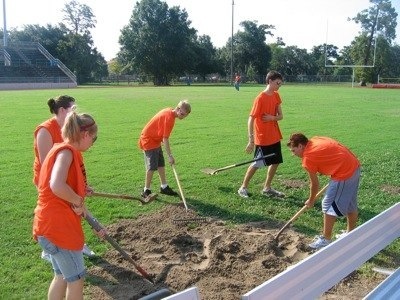
The organizers of the Gathering had explained to us that the situation on the ground was changing daily and so they couldn’t know in advance exactly where we would be or what we would be doing. When we first boarded our bus we were told that we were going to a day-camp where we would be working with children. When we arrived at the site it was actually a high school football stadium that was in need of attention. It seems the field had been a site for helicopters to land and ambulances and other transport vehicles to pull in and get the injured and sick out of the city after hurricane Katrina. All of this activity on wet ground had left ruts in the field and the flood waters had coated the concrete stands with algae and mold.

The first question that came to my mind was, how can this still be a problem after four years? Most of what we have seen in and around New Orleans looks pretty normal. We have not witnessed any blatant remnants of the hurricane damage. Once we started working I began to understand. Our tasks for the day were to paint a swing set, scrape and paint a locker room, fill in the ruts in the field, and power-wash the concrete stadium seating area. We came fresh and eager to dig in and get to work. I dare say we even came with a little attitude (it’s part of that midwest work ethic). Surely we could handle this.

Then reality set in. The tools and supplies we needed were not available immediately, and when they did arrive they were still in short supply. There wasn’t enough paint to cover all the surfaces that needed it. Rather than three or four power washers there was only one. And then there was the heat! I don’t know what the temperature was or what the official humidity level reached, but it was positively oppressive. In a very short period of the physical output required for this work zapped the energy out of everyone. We struggled to keep pouring in enough water to keep ahead of the dehydration. We all kept a high vigil over each other to head off any heat-related problems. Talking with Isaiah, the sole staff person at this facility, he thanked us over and over again. He said if it were not for our help all this work would be his solo task. Keith service

In the end we had to give up the effort a little ahead of schedule. And although we had accomplished much, many left feeling as though we could have done more, disappointed that the job was not finished. I told the group that this was true for just about everything God calls us to do. We rarely get to see the end of the job and there is always more to do than we have time, tools or the ability to do on our own. We have to give thanks for the ability to do what we can with the resources at our disposal and trust God to finish with the job with the hands of others.

At our mass gathering this evening the theme was Hope. Through the compelling stories of this evening’s speakers we heard that it is through small and large acts of kindness and love that hope springs for those who may have felt their situation was hopeless. Hope is the fruit of love, and hope breaks open a world of possibilities.

I am extremely proud of our kids for the gift of hope they provided this day. They served tirelessly and joyfully, and would have worked much harder and longer if we would have allowed them to do so. I did not hear one complaint nor one request to stop.

Day Four

A tour that expanded our understanding.

Saturday, July 25, 2009

Our day began with a bus tour of the city’s four major districts. We began with beautiful mansions and lush gardens and finished with the infamous “Lower 9th Ward” – the site of some of the worst devastation. It was quite a contrast going from beautiful historic mansions that were virtually untouched, to one of the poorest areas of the country nearly obliterated by the storm. In fact, if it were not for a few traces of concrete and paved streets you may not know anyone ever lived here.

It has been four years since hurricane Katrina hit New Orleans and so much remains to be done. It is humbling and maybe even a little disheartening to look at the tremendous amount of work left to be done. It would be easy to give up and just move on, but God rarely sends us down paths that are easy. When we hear the stories from people who have lived through these past four years, and when they show us photos from those first days I am encouraged. Progress has been made and things are much better, but there is still so much to do.

Our day finished off with another “Mass Gathering” at the Superdome – the same place that became an island of hope for the truly desperate survivors. There to kick off our final big night together we were greeted by the Mayor of New Orleans and received a personal “thank you” from him. That was followed by a letter of thanks and encouragement from none other than our country’s president, Barack Obama. You know you have been part of something truly significant and important when the President of the United States takes notice and is suitably impressed with your actions.

Day Five

Saying goodbye, telling the story.

Sunday, July 26, 2009

Our last day in New Orleans would be mostly a travel day. We would not be doing any projects, attending any workshops, or joining in the final “Mass Gathering” that would officially close our event. We would, however, say goodbye to New Orleans and begin reflecting on our experience.

While the kids enjoyed a welcome opportunity to sleep in a bit and then pack up for the trip home I stopped down in the hotel restaurant for a bite to eat. I decided to treat myself to a real meal for the first time since our first night in New Orleans. The restaurant was nearly empty (I was there kind of early), and so my waitress was waiting patiently for more customers to come. I asked her a simple question: “Do you live here in New Orleans?” When she said “Yes” I then asked the question that quite literally opened the flood gates: “Where were you when the flood came?”

Her name was Brenda and she had been on vacation with her family. And so she had to watch the events unfold along with the rest of the world. She couldn’t return home for two and a half months. The Marriott kept her and all the other employees on the payroll and even got emergency money from Mr. Marriott himself (she told all of this with deep appreciation). She lost several friends who were trapped and killed by the flood waters. Most of her family was scattered, thankfully all surviving, but most never to return to New Orleans. “I haven’t seen my one sister since the storm. I used to see her every Sunday. Now she’s just a voice on the phone to me.”

She spoke of her love for New Orleans and how this was where her heart is. She was grateful for the places that had been her temporary home while waiting to get back to the city, but said that nice as they were they were not home.  She also spoke with hope that others would eventually feel the pull of their hearts to return to New Orleans. Still, she said, “I don’t think New Orleans will ever be the same.” I suspect she is right. It will never be the same, but I do believe a new New Orleans will emerge from this experience, and I think I will like that city.

Now it is our responsibility to tell the story of the people of New Orleans. Ask one of the kids or chaperones who attended the 2009 ELCA National Youth Gathering about their experience.

ELCA Youth Gathering in New Orleans

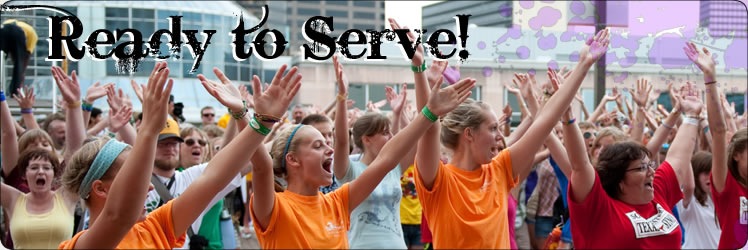
Ready to Serve

On July 22nd, 37,000 Lutheran youth and youth leaders descended on New Orleans for "Jesus Justice Jazz", the theme of the 2009 ELCA youth gathering, according to a news release from the ELCA. 

“Thank you.  Thank you.  Thank you,” said Mayor Ray Nagin to some of the volunteers who spread out to 200 separate work venues the first day.

“You’re welcome!" the volunteers responded.

“God is good!" the mayor said.

"All the time!" the volunteers shouted.

On Friday evening, the Lutherans came together at the Superdome for the opening ceremony, as bursts of dancing, spotlights, and bass notes drove deep through the crowd.  A speaker, covered with tattoos and piercings, spoke “about God accepting people where they are in spite of the mistakes they’ve made.”

“That was the message that distinguished Martin Luther nearly 500 years ago,” he said. "Thank God for grace."

"There are millions of Christians out there suffering because they don’t feel God loves them. They’re dying to know they’re loved."

The official website of the ELCA is chock full of pictures, videos, news releases, and more.  Here is a list of links for slightly less official views from participants.

St Mark’s of West Des Moines, The Lutheran Magazine, Women of the ELCA, Our Saviour’s of Naperville, Lord of Life of Maple Grove, Spiritualevity from suburban Philly, Elim Lutheran of Duluth, Lutheran Church of the Master of Coeur d’Alene, and Our Saviour and St. Jacobus of NY.

Pitcher-Pastor Charlie Ruud greets his team

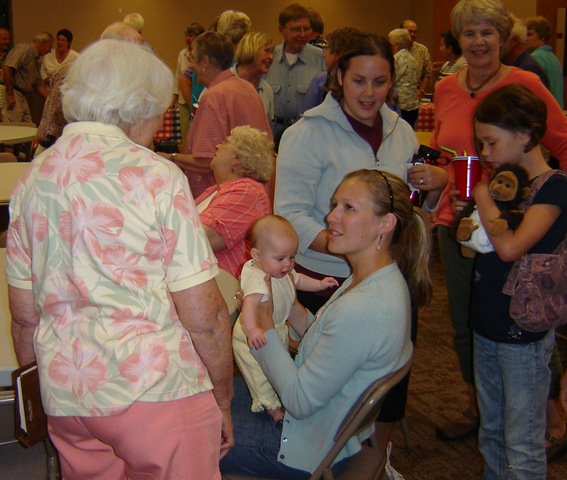
Charlie Ruud 001 Fresh from the mound of the St Paul Saints baseball team and soon to the pulpit of Northfield’s Bethel Lutheran Church, Pastor Charlie shared root beer floats with Bethelites Wednesday night.  An estimated gathering of 75-100 persons listened to Charlie discuss his seminary experience and later greeted Charlie, his wife Becky, and their baby daughter, Lucy, who was clearly more popular than her parents.

Once a star pitcher for St Olaf, Charlie has continued his love of baseball as a record-setting hurler for the St Paul Saints minor league team.  Charlie recently graduated from Luther Seminary in St Paul, and he will join the Bethel team this fall as associate Pastor.  During seminary, Charlie did his clinical, pastoral training at Northfield Retirement Community.

Charlie Ruud 006Charlie and Becky met at St Olaf.  Becky also excelled athletically as an All-American track star, five time MIAC conference champion, and three time St Olaf track team MVP.  She puts her degree in Spanish to use as a high school Spanish teacher, and she has been an assistant track coach at St. Kates.  She is starting a cottage business featuring OwlyBaby handcrafted clothing.

The get together was part of the What’s Brewing at Bethel? summertime socials arranged by Pastoral Minister, Pam Santerre.

The Bishops did it!

In the bicameral legislative system of the Episcopal General Convention, the LGBT community has been holding its breath awaiting the action of the House of Bishops.  Earlier, the House of Deputies voted overwhelmingly to adopt a resolution that would effectively counter the 2006 resolution that put a halt on ordaining gay bishops.  Now, the House of Bishops has done the same.

Here is the press release from Integrity USA, the Episcopal LGBT advocacy group:

FOR IMMEDIATE RELEASE

ANAHEIM, CA (July 13, 2009)–By a nearly 2-1 margin, the bishops of the Episcopal Church passed an amended version of resolution D025, which effectively ends the "BO33 Era" and returns the church to relying on its canons and discernment processes for the election of bishops. "While concurrence on the amended resolution by the House of Deputies is necessary before it is officially adopted by the church as a whole," said Integrity President Susan Russell, "there is no question that today’s vote in the House of Bishops was an historic move forward and a great day for all who support the full inclusion of all the baptized in the Body of Christ."

"It was a tremendous privilege to be a witness to the courage and candor of the bishops who spoke truth to each other and to us–and who called the Episcopal Church to speak our truth to our Anglican Communion brothers and sisters and to the world.

"The truth is we are a church committed to mission–we are a church committed to the full inclusion of all the baptized in that mission–and we are a church committed to creating as broad a place to stand as possible for ALL who wish to be part of this great adventure of being disciples of Jesus.

"In this carefully constructed and prayerfully considered resolution, our Presiding Bishop got what she both asked for and voted for: a positive statement about where we are as a church in 2009–a church striving to actually become the church former Presiding Bishop Edmond Browning called us to be nearly 20 years ago now…a church where there are no outcasts."

"The debate on the floor of the House of Bishops made it VERY clear that our bishops knew exactly what they were doing when they passed this by a nearly 2-1 margin. The resolution passed today by the House of Bishops was another step in the Episcopal Church’s ‘coming out’ process–and it sends a strong ‘come and see’ message to anyone looking for a faith community where God’s inclusive love is not just proclaimed but practiced."

It’s a good day to be an Episcopalian.  For watchers of LGBT issues within Christian communities, the next event will be the ELCA convention in MPLS in August.  As I have noted previously, I will be present and will live blog the Lutheran gathering.

Full inclusion of all the baptized in all the sacraments

I am following the Episcopal general convention through several RSS feeds, and one of the best is through Integrity USA’s blog, “Walking with Integrity”, which provides their own YouTube video updates entitled, “IntegriTV”. Integrity USA is the LGBT advocacy group within the Episcopal Church, and their motto is “full inclusion of all the baptized in all the sacraments.”

Yet, what seems so simple, obvious, and Christ-like remains an unrealized ideal in so many settings.

An ELCA pastor friend of mine married a country gal from South Dakota whose father was the local county sheriff, and the family belonged to a Missouri Synod congregation. When the newlyweds first visited, elders within the church kindly informed the sheriff that his new son-in-law would not be welcome at the table. The sheriff and his wife did the right thing and promptly resigned their membership in the congregation they had belonged to their entire lives.

Years ago when I took graduate classes at St John’s School of Theology in Collegeville (a Benedictine Community), I was a welcome addition as a Lutheran. The students consisted of three categories a) candidates for the priesthood, b) nuns and other Catholic women, and c) miscellaneous protestants such as myself. One evening a week, the resident students invited the non residents to a meal in the dorm dining room followed by a prayer service and Eucharist. Protestants participated in the Eucharist until a couple of priest candidates objected, and with much pain on the part of most of the Catholic teachers and students, the practice ceased.

child of god
A blogpost this morning tells another tale of pain following rejection at the Lord’s Table. Blogger Sarcastic Lutheran reports an 11 am Sunday phone call:

Finally in a shaky voice, this came out: “I’m at my parent’s church….they are doing communion…..and I’m not allowed to take it.”

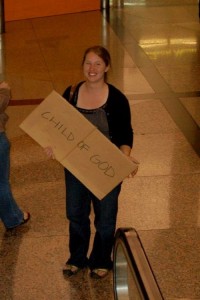
The blogger is the mission developer for “House for all Sinners and Saints” — “a group of folks figuring out how to be a liturgical, Christo-centric, social justice oriented, queer inclusive, incarnational, contemplative, irreverent, ancient – future church with a progressive but deeply rooted theological imagination.” She did the right thing and brought Eucharist to the young woman at the Denver airport.

The Rainbow Sash folks over in the Catholic Church seek to let the rest of their church know their pain of exclusion as LGBT persons.

When James, the brother of Jesus and leader of the church in Jerusalem, sent word to Antioch that Peter must refrain from table fellowship with unclean Gentiles, Paul understood the pain of exclusion, left in a huff, and the mission of the Apostle to the Gentiles began in earnest. History reminds us that we must ever fight the good fight, even when church leaders warn against rocking the boat.

A word from the conventions, Part II: UCC, Episcopal, ELCA

An earlier post reported on the closing of the Mennonite USA convention and the opening of the United Church of Christ (UCC) General Synod. Since then, the UCC has concluded its business; meanwhile, the triennial General Convention of the Episcopal Church will convene in Anaheim on July 8.

Ballots

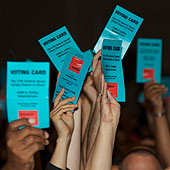
The main order of business for the UCC was the pro forma election of The Rev. Geoffrey Black to succeed the Rev. John Thomas as General Minister and President. Thomas was ineligible for an additional term. That Black was selected without opposition symbolized the unity and lack of divisive issues at the 27th General Synod. The UCC is one of the mainline Protestant denominations that welcomes gay clergy, and they appear to be at peace with the issue.

The Episcopal Church is also a denomination that ordains gay clergy, but the issue continues to roil. At the 76th General Convention since 1785, LGBT issues will dominate:

The Episcopal Church’s 45-year debate over human sexuality and the appropriate response to the desire of lesbian, gay, bisexual and transgendered people to participate fully in the church’s life will occupy General Convention’s attention once again as it meets July 8-17 in Anaheim, California.

Deputies and bishops are being asked to reconsider the 2006 convention’s stand that the church “exercise restraint by not consenting to the consecration of any candidate to the episcopate whose manner of life presents a challenge to the wider church and will lead to further strains on communion.”

Episcopal News Service, July 6, 2009

The Episocopal Church is part of the worldwide Anglican communion, and the 2006 resolution sought to mollify international concern with the episcopacy of gay Bishop Eugene Robinson of New Hampshire, in a classic “don’t rock the boat” expression of church polity over principle. As the 2009 General Convention approaches, the Episcopalian blogosphere is electric with anticipation.

Elizabeth Kaeton, a self-described “joyful Christian who claims the fullness of the Anglican tradition of being evangelical, Anglo-Catholic, charismatic, orthodox and radical”, serves as Pastor of an Episocopalian parish in New Jersey. In her “Telling Secrets” blog, she has a telling video that addresses the perception that all African Anglicans have a negative attitude toward gay inclusion.

From the opposite coast, Pastor Susan Russell of California offers regular updates and a photo montage of the Integrity Team in preparation for the General Convention at her “Inch at A Time” blog. Pastor Russell also serves as President of Integrity USA, “a faithful witness of God’s inclusive love to the Episcopal Church and the lesbian, gay, bisexual, and transgender community. We are working for the full inclusion of all the baptized in all the sacraments,” and the Integrity blog also has frequent updates.

Meanwhile, ELCA members and churches continue their 50 day prayer vigil that points toward their 2009 Churchwide Assembly in Mpls that begins August 17 and which will consider the ELCA versions of LGBT resolutions. I plan to be present in MPLS to liveblog the daily events.