Tag Archives: ELCA

A word from the Conventions: UCC, Mennonite, NOW, ELCA

The United Church of Christ General Synod convened in Grand Rapids, Michigan on Friday, June 26, and will adjourn on Tuesday, June 30th. The 27th synod is graced with 3,500 attendees. Here are a few highlights, so far.

Trinity UCC in Chicago made headlines last year as the home church of Barack Obama and fiery Pastor Jerome Wright. Pastor Wright has retired, but the church was represented by Pastor Otis Moss III who delivered an impassioned sermon to the gathered on Friday night.

God says I am the Alpha and the Omega, COMMA, who is, COMMA, and who was, COMMA, and who is to come, COMMA.

In a mind-jolting, three-minute recitation of the history of Christianity, Moss shouted a COMMA between each event, all the way through to the 1957 creation of the United Church of Christ and the presence of John Thomas as General Minister, who introduced him Friday night.

Don’t get angry with the haters, the Rush Limbaughs. Next time you hear them, just say, ‘COMMA!’ When you see Dick Cheney, just say, ‘COMMA!’ Remember, there used to be a period on Pennsylvania Avenue. At Calvary, death wanted to place a period, but Jesus got up on Sunday morning. ‘COMMA!’

Official actions of the synod will include the election of a General Minister and President of the UCC, Conversations on Race (a theme introduced by outgoing General Minister John Thomas within the last year) consisting of various workshops and discussion centers, seventy new UCC congregations were highlighted and celebrated, journalists Eugene Robinson and Ray Suarez addressed the assembled, all punctuated with commas, shouts, singing, and dancing.

Daily digests of synod happenings are available at the UCC website.

As the UCC General Assembly closes on the 30th, the Mennonite Convention 2009 convenes in Columbus, Ohio and will run through July 5th. The theme is “Breathe and be Filled,” and a Youtube video provides the anticipation.

Daily happenings can be followed at the Mennonite USA website.

Meanwhile, at the National Organization for Women (NOW) convention that adjourned a week ago, a new leadership slate was chosen. Terri O’Neill’s team, which takes office July 21, includes Bonnie Grabenhofer of Illinois as Executive Vice President, Erin Matson of Minnesota as Action Vice President, and Allendra Letsome of Maryland as Membership Vice President.

Finally, many ELCA congregations nationwide are answering the Presiding Bishop’s call for 50 days of prayer in anticipation of the Churchwide Assembly that will convene in Mpls on August 17th. The much anticipated assembly will deal with major resolutions regarding LGBT issues including gay clergy and same-gender marriage.

I plan to be present at the assembly to provide live-blogging updates.
Quick check of denominational news

This blog contains a page (see the sidebar) called From Headquarters that contains RSS feeds downloaded from the official websites of progressive denominations or religious organizations. For those of you unfamiliar with the concept of an RSS feed, it is a subscription to real-time updates of the latest entries from a website or blog. The feed is typically a headline that a reader can click on for the whole story.

Here’s a sampling of the headlines that appear as this post is being written.

From the Alliance of Baptists website, we see the headline “Being Ecumenical” which is a clickable link to the full story that starts with the following paragraph:

During my initial involvement as a representative of the Alliance of Baptists at the National Council of Churches, I grew to realize that all I need to know about ecumenism, I learned in Hurdle Mills, N.C. — not from my home church, but from the farming community in which I was nurtured.

Here’s another. From the official website of the ELCA, we see the headline, “Lutherans Open their Church Doors to Immigrant Families”, which clicks to the following opening paragraph from the ELCA news service article,

CHICAGO (ELCA) — For Howard Lamont being welcoming to the immigrant population is “simply part of the Christian message.”

And another. From the Mennonite Church USA comes the headline, ” Mennonite Church USA Convention 2.0″, and the clickable link takes the reader to a news release of instructions for following their general convention online.

NEWTON, Kan. — Mennonite Church USA Convention 2009 will take place in Columbus, Ohio, June 30 to July 5, but people who don’t make the trip physically can still experience convention on the Internet like never before.

And finally, one more. From the Action Center for Reform Judaism comes the headline, “At Interfaith Service, Saperstein Stresses Urgent Need for Health Care Reform”, and the link will take the reader to the full article about the comments of Rabbi Saperstein.

WASHINGTON, D.C., June 18, 2009 – At today’s Interfaith Service of Witness and Prayer for health care reform, sponsored by more than 40 national faith organizations and religious denominations, Rabbi David Saperstein, Director of the Religious Action Center of Reform Judaism, spoke of the pressing need for health care for all and encouraged our nation’s leaders to pass health care reform legislation this year.

So, the point is that this page of headlines From Headquarters is a quick and easy way to see what’s up as reported by various religious organizations. I hope you find this tool to be handy and helpful.

Schism is in our genes

Those of us in the Judao – Christian family tree have a long history of internecine struggle and splits. I suppose we could go back even earlier and talk about Isaac and Ishmael if we want to include the Muslims in this family history. The Pharisees disagreed with the Sadducees over Torah and the Temple, and the Essenes had enough of each and ran away to the desert. Paul split with Peter and started his own Gentile mission apart from the Jewish Jesus movement in Jerusalem. Later, the Christians and the rabbis disagreed over who could worship in the synagogues. First, the Coptics retreated to Egypt; then, the Greeks packed up for Constantinople leaving the Catholics in Rome; and a millenium later, Luther spewed nourishment to new nestlings.

So why should I be surprised when several blogposts come through my RSS reader today about schismatics in today’s christendom?

Several hundred former Episcopalians, meeting in a school gym near the Dallas-Fort Worth airport, ratified a constitution Monday for the fledgling Anglican Church in North America as a direct challenge to the Episcopal Church USA and the Anglican Church of Canada.

So says the Washington Times online.

Frederick Clarkson in Talk to Action blog points out that noted evangelical Rick Warren spoke at this meeting, inciting the schismatic sentiment.

The Presbyterians apparently have the same schismatic genes. According to Pastor John Shuck on his Shuck and Jive blog:

When the two main branches of the Presbyterian Church finally decided the Civil War had ended in 1983, they reunited. Ten years prior to reunion, some congregations of the then “southern branch” broke away and formed their own denomination. The larger church had become too liberal for their tastes.

Each of these two latter day stories relate to LGBT issues, and whispers of schism within my own ELCA waft on the breeze emanating from the direction of the WordAlone Network if the ELCA does what the Network fears this summer and allows a local option for gay clergy and gay marriage. Fear of defections from the ELCA causes some to wring their hands and advocate for the status quo.

Schism is part of our history and undoubtedly part of our future. When defections occur, we should grieve the losses and then move on, but we should not retreat from principle. We should not fear history, nor should we ignore it, nor can we stop it.

An ELCA sexuality statement and assembly primer: #CWA09

ELCA assemblyOn August 17, “1,045 voting members from 65 synods and 10,448 congregations serving on behalf of the 4,709,203 baptized members of the Evangelical Lutheran Church in America” will convene in Minneapolis for the 2009 biennial assembly. I will be there, too, and I plan to liveblog during the six day event.
There will be worship services, workshops, and plenty more to keep delegates busy, but all eyes will be on the plenary sessions in which the ELCA sexuality statement and LGBT issues will be debated and voted upon. The following is an overview of players and constituencies likely to play major roles or have significant interest in the proceedings.

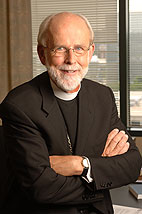
Bishop Hanson

Presiding Bishop Mark Hanson. In the ecclesiology of the ELCA, this is an elected position for a limited term. The presiding Bishop is largely an administrative position without significant legislative functions. The body of delegates at this and other biennial conventions have ultimate legislative authority.

Church Council (Council of Bishops). Each of the 65 synods has a presiding bishop. As a collective body, the bishops serve as the Church Council, which acts as board of directors and legislative body between biennial assemblies. When the Church Council met late in March, it voted to submit the ELCA sexuality statement to the churchwide assembly for consideration. Significantly, it also set guidelines in which voting decisions on the statement would proceed according to majority vote (opponents of the various measures prefer a 2/3 or supra-majority standard). Of course, since the assembly itself has final legislative authority, these standards could be changed, and early skirmishes over procedures are likely to be telling during the assembly.

Sexuality Study Task Force. At the 2001 biennial assembly, a resolution was passed to create a task force to study and report on a proposed social statement on human sexuality.
Although the composition of the task force has changed over time, it has consisted of 27 appointed persons, most recently under the leadership of Pastor Peter Strommen (formerly the bishop of the NE synod of Mn and a personal friend of mine). The proposed Sexuality Statement is the work product of this task force. Three general comments can be made about the Statement: first, it is generally favorable toward LGBT persons; second, it allows LGBT persons in a committed relationship to become rostered clergy based upon local, congregational option; and, third, it is silent regarding “gay marriage”, but that may also be subject to local congregational decision.

Of course, there are advocacy/interest groups on both sides.

Since 1974, a group called Lutherans Concerned has advocated on behalf of LGBT Lutherans. This group’s official posture regarding the proposed statement is mostly positive since gay clergy will be allowed according to local congregational option but also concerned that the local option rule will also allow pockets of dissent within the ELCA that will fester over time. But the biggest criticism pertains to the absence of “a means of public recognition of same-gender relationships, no rite of blessing or marriage. Unacceptable, but correctable inconsistency.” Press release Feb 19, 2009.

Another organization supportive of LGBT issues is The Lutheran Network for Inclusive Vision, and their website may be found at The Network.

Perhaps the most proactive, pro-LGBT group is Goodsoil, and they solicit assembly delegates and other volunteers to offer a full range of advocacy activities during the assembly. I have joined this group and will volunteer my services during the assembly.

On the right is the well-known conservative movement within the ELCA known as the WordAlone Network. Originally founded in 1996 to resist the ecumenical agreement with the Episcopalian Church, the group has continued over the years to offer a conservative point of view within the ELCA. They now claim a membership of over 6,000 ELCA Lutherans and 1,000 clergy. Their website includes the following statement:

WordAlone’s primary concern is that the ELCA is losing its Christ-centered focus. ELCA churches and members are turning to authorities other than the authority of God’s Word, revealed in his risen Son, Jesus Christ, and in his inspired Word in the Holy Scriptures. The other authorities – human experience, wisdom and tradition – are used to turn aside the authority of God’s Word.

As to the Sexuality Statement specifically, the WordAlone Network claims that the ELCA usurps divine authority.

The usurped authority resolution criticizes the ELCA for voting on matters governed by Divine Law when it has no legitimate authority to do so and for sending proposals that “explicitly reject Scripture’s clear, consistent witness concerning marriage and sexuality” to the churchwide assembly.

It will be an interesting summer in the ELCA, and I will keep you posted from my vantage point on the left side of Northfield, Mn.

Rainbow Sash followup: GLBT Catholics

Last week, before Pentecost, I posted on the upcoming Rainbow Sash plans for Pentecost mass at the Cathedral of St Paul (Minnesota).  A reader asked what happened at that mass, and here is what I know.

Michael Bayly, in his blog Wild Reed, quotes extensively from Brian McNeill, Rainbow Sash organizer … who disrupted the Pentecost mass?

“Was it the thirty people who quietly and prayerfully were present as gay, lesbian, bisexual, and transgender Catholics?” he asks. Or was it Archbishop Nienstedt and Fr. James Adams who “perhaps intentionally opted for the alternative reading from Galatians because it served their sectarian and political purposes . . . [among them to] discredit the wearers of the Rainbow Sash as disruptive protesters?”

Paula Ruddy, in a lengthy and insightful post called “One Archdiocesan Community, Two Mindsets” on The Progressive Catholic Voice goes beyond the issue of GLBT Catholics and suggests there are fundamental differences in the view of “church”:

The Archbishop, as a good leader, wants to maintain order. He is focused on the external behavior of respect and reverence for the sacrament, shown in this case by not drawing attention to the fact that there is disagreement among the communicants. He is concerned for the inner life of the church in that to function well the members should be in agreement on all the basics and obedient to the leaders. The Church is one body, thinking alike, acting reverently, producing a right minded, godly membership. He is speaking like a Communion Catholic.

The Rainbow Sash Alliance, on the other hand, wants to affirm difference. There are many ways we are not alike. Perhaps it would be acceptable to leave differences at the door of the Cathedral when going in to celebrate Mass if there were a forum within the Archdiocese for bringing them up and having them affirmed in another venue. But there is such a high value on uniformity within the Communion leadership, that there is no room for difference. Individuals who do not fit are stifled. GLBT persons do not fit the mold, defined in formulations about sin. People who question do not fit the mold, defined in dogmas and “unchanging truths. [These are Kingdom Catholics.]”

This is a variation on the theme of “polity vs policy”.  That is, what is more important … denominational unity, harmony, peace, etc. (polity) or an underlying issue of injustice (principle)?  In my own ELCA, there will be a contentious national assembly this summer in Mpls over the issue of gay clergy.  Many who resist the movement toward ordination of gays suggest that will be disruptive, schismatic, unsettling, etc., and I suspect they are right.  If church unity (polity) is most important, then the ELCA should not ordain gays. 

But, did Martin Luther or Martin Luther King worry about the unsettling consequences of their actions as they advocated for change (policy)?

Gay female bishop

I suppose most of us are proud of our ancestry.  This week, I am especially proud to call myself a Swede upon news that the newly elected Lutheran bishop of Stockholm is a lesbian in a state registered homosexual partnership with another priest.  That she is Lutheran is also a source of pride for me, and since my hometown is Upsala, Minnesota, the election of Rev. Eva Brunne from Uppsala, Sweden just makes it all the sweeter.

Episcopalian pastor and blogger Elizabeth Kaeton of Telling Secrets has the details in her post entitled “Another purple shirt with a pink triangle.”  Kaeton reports:

Brunne, who is currently the dean of the Stockholm diocese, is the first Church of Sweden bishop to live in a registered homosexual partnership, the Uppsala-headquartered church said, and she is believed to be the first openly lesbian bishop in the world.

Brunne, 55, lives with priest Gunilla Linden in a partnership that has received a church blessing. They have a three-year-old son.

A comment following her post laments the lack of media attention to this breakthrough event compared to the extensive and continued coverage of the election of Eugene Robinson, an openly gay Episcopalian priest, to the bishopric of New Hampshire.  Perhaps Europeans are more tolerant than Americans suggests one commentor or perhaps this is an evidence of sexism suggests another.

When the choice is between a story about a handsome Catholic priest who’s been photographed with a woman . . . and a story about two Swedish priests who are living together in a monogamous relationship, you know which one is going to grab all the attention.

As a hetero male, I would like to be counted among those “few good (straight) men” that Kaeton refers to in a separate blog post.

Solidarity is a powerful thing. It can embolden the bold who have become temporarily weary by the struggle.

It speaks a silent but powerful truth to power.

And, I know that those of you – LGBT and straight – who enjoy the sacramental grace of marriage will not know complete sacramental fullness until everyone who is called to stand where you are privileged to stand is allowed to pursue their vocation to marriage and family life.


solidarity

Prima not Sola Scriptura (Updated)

A twenty-year old seminarian, Blake Huggins, suggests that the Reformation cry of Sola Scriptura is outdated, but that substituting Prima Scriptura suggests a continued reliance on the primacy of Scripture.  I think the young man is right, and I recommend reading his entire blog post at Emergent Village Weblog.

So, admitting the immanent [sic, but interesting] end of Sola Scriptura is not a categorical rejection of Scripture as much [sic, less interesting]; rather, it is a coming to terms with our own limitations and finitude as human beings and adopting a certain humility about our readings. I seriously doubt whether the Bible is infallible since it was written by pre-modern men (yes, they were men). But that doesn’t mean I don’t think the Bible is authoritative or instructional.

This ties into the discussion on Doug Kings’ blog, Cyber Spirit Cafe,  in which he suggests that our ELCA is not honest about Scripture with the people in the pew.  See my earlier post on the subject.  I like the line, which I paraphrase, our seminaries teach the historical critical method, but whisper on the way out ‘don’t tell anyone’.  Doug is especially critical of the ELCA “Book of Faith Initiative” which he sees as a wishy-washy, don’t offend anyone, response to Biblical illiteracy, which only perpetuates the problem.

Doug also suggests, rightly I think, that ambivalence about how we read Scripture is at the core of denominational struggles with issues such as gay clergy.  In the ELCA,  the conservative opposition to all things new calls itself, “Word Alone”, which confirms that the threshold issue is how we relate to Scripture.

Doug suggests we deal honestly with what Scripture is and what it is not and let the chips fall where they will.

UPDATE:

In a hard hitting and incisive post, Pastor John Shuck of Shuck and Jive, criticizes today’s California SC Prop 8 decision by challenging a “high view of scripture”, ie the sense that the Bible is divinely inspired and hence beyond criticism.  He argues that certain Christians, in reliance upon their misguided interpretation of scripture and fundamental misunderstanding of what Scripture is, are responsible for the California decision.

If there is going to be any forward movement for humanity, we will need to relieve ourselves of our superstitious past. This will include the evolution of Christianity into something that is reasonable and decent. The key will be discarding the authority of any supposed “special revelation.”

The Bible is a book. It is like all books, creeds, liturgies, songs, and rituals, created by human beings. Most of the Bible isn’t even that good. Until we can admit that reasonable piece of common sense, we will continue to make life more miserable for our fellow creatures and for Earth itself.

Whew.  Tell us what you really think, Pastor Shuck!  Read his rant in his blogpost, but its not for namby pambies.   Shuck and Jive: Prop 8 and Superstition

A new church home

Last Sunday, my wife and I joined a new congregation, only the second church I have ever belonged to other than the one I was baptized and confirmed in, returned from afar to raise our family in, buried my mother in, and where I served as president, sang in the choir, and taught adult education. 

But change is good.  We have moved to a college town and retirement community.  The new church is bristling with energy from all ages.  We were one of twenty-one family units to join on Sunday, including 5 retired pastors and a professor or two. I have volunteered to teach adult ed, but this will be a pretty sophisticated crowd.

There is plenty of excitement about my novel about Paul the apostle to be published this fall, but I worry that it may be offensive to some.

swap claim code

Technorati Profile

Gay marriage scoreboard

From the ashes of disappointment following the California Prop 8 results in November, new hopes arise this Easter season with a string of court and legislative victories.  Starting with the unexpected court mandate of marriage equality in Iowa, legislative victories in New England have gained momentum with the latest news that the New Hampshire governor will sign a marriage equality bill once the legislature works out minor details.  New York and New Jersey may soon follow.

Despite the “sky is falling” predictions of many conservatives, the Massachusetts experience proves the opposite.  May 17th will be the 5th anniversary of the first same-sex marriages in Massachusetts.  The occasion will be a time of celebration and reflection.  Michael Cole in the HRC Back Story blog provides a brief retrospective, including video of early celebrations, on the historic Massachusetts day five years ago.

From the standpoint of Christian denominational support for GLBT equality, the national convention of the ELCA in Mpls this summer will be the next battlefield.  Early procedural skirmishes suggest that chances are good that the ELCA will join the Episcopal church and the UCC as mainline denominations that support gay clergy ordination and marriage equality.

Just what is the Bible and how do we use it?

A recent post by Doug Kings  has stirred things up at the  BOFI (Book of Faith Initiative).  BOFI  is an ELCA effort at energizing Bible study, but Kings, a Chicago pastor, is skeptical.

The church does indeed have a Bible problem but it’s not people’s ignorance about it. The question is whether the church can let the Bible be what it is: the collected thoughts of a particular ancient people, containing their prejudices and ignorance but also some genuinely profound insight into living with God and with one another in our paradoxical world of beauty and pain, purpose and confusion.

The sexuality task force, with commendable candor, admitted the ELCA lacks a basic consensus on how to read the Bible. Without such a consensus, we will continue to flail about, squabbling among ourselves, uncertain of our mission. How the Bible should be read today is not obvious.

As one who has taught adult Bible education in my own parish for a number of years, I share Kings’ critique of the church’s ambivalent attitude towards the institution of scripture.  Kings suggests the ELCA seminaries teach the historical critical method, but whisper on the way out, but don’t tell anyone.  The “Word of God” is understood as the “words of God” without correction.

I belong to a men’s group at my present parish consisting of retired, mostly professional men with long histories in the church.  Nearly a quarter are retired clergy.  Yet, I bite my tongue at the misconceptions: John the apostle was the same person as John the evangelist; the same for Matthew; 2nd Peter’s comment about the transfiguration proves that it was a historical event (after all, Peter was there!); the consistency of the synoptics proves their truth.  And these all just at yesterday’s meeting!

Yet, I challenge only selectively.

Wellhausen, the 19th century scholar most associated with the Documentary Hypothesis (JEPD) and the historical critical method, supposedly stopped teaching it near the end of his career because it didn’t lift up the faith of his students but actually detracted from it.  He didn’t reject the accuracy of the approach but the utility of it.  So too is the church’s ambivalence and my silence in the face of the misconceptions of my men’s group. 

Kings suggests that we simply need to be honest about what the Bible is and especially what it is not:

Modern scholarship has actually discovered a great deal about the Bible but much of it is ignored because it doesn’t tell us what we want to hear. Modern biblical study’s totally unsurprising conclusion is that the Bible is theology, through and through. Thus, it isn’t history, biology, geology, astronomy, economics, political science, psychology or any of the other contemporary subjects which so fascinate us and about which we have so many questions. For answers to them, we must look elsewhere.

He is right, of course, but the difficulty lies in challenging inbred assumptions without seeming to question faith.