Tag Archives: ELCA

ELCA Book of Faith Initiative Embraces Online Social Network


CHICAGO (ELCA) — Members of the Evangelical Lutheran
Church in America (ELCA) are reading and discussing the Bible
as part of the church’s Book of Faith initiative. That
discussion is being propelled with Internet technology.

An estimated 2,400 members have signed on to the Book of
Faith social network — http://bookoffaith.ning.com/ — made
possible through Ning, an online platform for users to create
their own social networks.

“Ning is really very similar to Facebook,” said Bill Huff,
assistant director for the Book of Faith initiative, ELCA
Vocation and Education, St. Paul, Minn.

“Social networking is one of the fastest growing vehicles
for personal communication right now,” Huff said. “The essence
of Book of Faith is that it’s not a program. We don’t want it
to be a top-down initiative,” he said.

“The motivation for a social networking site is to stay
in contact with individuals and to be in contact with large
groups of people who have similar interests,” Huff said. “You’ll
be able to socialize with your colleagues throughout the country,
but also you’ll be able to share ideas and be able to see what
other people are doing.”

“The Book of Faith tag line is ‘Open Scripture. Join the
Conversation.’ So much of what the Ning site is about is joining
the conversation,” Huff said. “Once you’re signed up you have a
profile, and you can tell a little bit about yourself. Then you
can join the conversation.”

Someone reading the Bible can find study helps as well as
others who may be reading on their own. There are more than 45
videos and other resources on the site. There is an area of the
site to find or add events.

Augsburg Fortress, the publishing ministry of the ELCA,
Minneapolis, established the Book of Faith’s Ning site.

The initiative is generating resources in congregations
across the church, and the Ning site is a means for sharing
“what’s working in my setting,” Huff said.

“If you are a Sunday school volunteer, you can go on to
the conversation piece and see what’s going on with people as
they teach their kids,” he said. “People post ideas, but also
people post questions or theological concerns.”

“The goal is to get people engaging in Scripture, so
anything we can do to help that along is meeting the mission
and will help the ELCA,” Huff said.

Muslim integration in the West


Here are two articles about Muslim integration into western society. The first is from my local newspaper, the Mpls Star Tribune, and features Augsburg, an ELCA college in Mpls. The second is a Reuters release about attitudes revealed in polling in the western democracies of Europe that suggests Muslims are less integrated in Europe than in America.

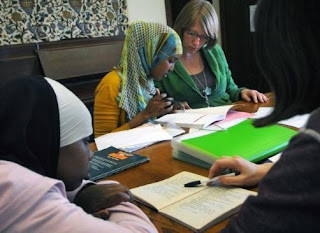
Not so long ago, Fadli Mohamed would not have fit the mold of typical Augsburg College students: She’s no white Lutheran kid from the suburbs.

But change has come rapidly to the small, 140-year-old Lutheran college that shares its Minneapolis Cedar-Riverside neighborhood with the highest concentration of Somali people in the United States.

For years Augsburg has reached out to its immigrant Muslim neighbors, helping to care for their infants, tutor their high school students and feed their elderly as part of the college’s service learning program.

Now children from those Somali families, people like Mohamed, are increasingly enrolling at Augsburg, rising from a handful three years ago to more than 30 this year. It’s still a small fraction of the 1,900 daytime undergraduates, but they’re a notable presence among those lending a hand to the neighborhood.

“It gives a different face to the college’s volunteerism and service,” said Mohamed Sallam, director of the college’s Pan-Afrikan Center. “These are students who may or may not come from this neighborhood but feel connected to it through ethnic and religious identity. They are products of the community and they’re giving back in such a way where members of the community can feel very proud.”

Students volunteer in the neighborhood, but they study there, too. A journalism class interviewed people from different backgrounds to create a cookbook called “The Taste of Cedar-Riverside.”

Mary Laurel True, associate director for the college’s Center for Service, Work and Learning, said the program is not an add-on. “The whole idea of service learning is that it’s integrated into the classroom, into everything we do.”

Augsburg undergraduates are required to take two religion courses, and in studying Islam, they hear about the faith from people who practice it, often visiting one of the four mosques within blocks of the school.

“Here we are, this Lutheran institution, and yet we have this rare gift to experience — not just read about, but experience — other people’s faith,” said Paul Pribbenow, the college’s president since 2006.

After being greeted by imams at the mosque, students take off their shoes, enter and observe people praying, said assistant Prof. Jeremy Myers. His introductory religion course is called “Christian Vocation and the Search for Meaning,” but he’s hoping to add “in Cedar-Riverside” to its title.

There, students “experience hospitality,” Myers said. “Especially in the last eight years — and even within the last few months — it’s important that they learn what Islam is and what it’s not. It’s important that people see the truth or a different side of the truth.”

Embracing the city

Augsburg College was founded as a Lutheran seminary in rural Wisconsin in 1869 and relocated three years later to Minneapolis. Early in the 20th century, the school “embraced the community and saw Minneapolis as a place of opportunity and service,” a chapter on Augsburg in a 1998 book titled “Successful Service-Learning Programs” recounts.

However, the school also has a long history of “organized efforts … to move to the suburbs for ‘more room and fresh air … more desirable locations,'” according to the text.

That tension occasionally resurfaced over time.

“If you go back even 10 years ago and look at some of Augsburg’s admissions materials, they often talked about this college as an oasis in the city,” Pribbenow said. “And I think what has shifted is that now we’re saying, we are no oasis. This is it. This is the city. We are the city.”

The makeup of the college’s incoming class has changed substantially since 2005:

Then, students of color made up 10.7 percent of the incoming class; last fall it was 17.9 percent. In 2005, the college tended to attract students from the suburbs; in 2008, the greatest number of incoming students came from Minneapolis high schools Henry and Roosevelt. The number of students who list their religion as Lutheran has dropped over that time, while the number of those who listed a religion other than Lutheran or Catholic has grown.

The appeal of Augsburg

Somali students come to Augsburg for the same reasons as any other students: Small classes, an urban setting, a focus on community service.

As a high school senior, Fadli Mohamed had her college choices ranked, with Augsburg in second place. Then she happened to meet Augsburg students who were tutoring her neighbors in English.

“They were so friendly,” said Mohamed, now 19. “Seeing people from the school doing something positive where you live — it made a huge difference.”

The number of Somali and Muslim student groups and services has grown along with the students. There’s the Pan-Afrikan center and student union — which brings together African and African-American students — as well as the newly-founded Muslim Student Association.

One of the students who helped start that group, Ahmednur Ali, was shot to death last fall on his first day volunteering at the Brian Coyle Community Center in Cedar-Riverside. The 16-year-old charged in his death reportedly shot him because Ali wouldn’t let him play basketball. Ali was the first Augsburg student to be fatally shot in the college’s history. In some ways, his passing brought the Augsburg and Somali communities closer, several students and leaders said.

People with the college talk about how Sallam and other Muslims helped fashion Ali’s memorial service so that it was reflective of Islamic traditions.

People with Somali organizations talk about how, despite some trepidation, students continued to volunteer. About how President Pribbenow was ever-present during that time.

“He came and said condolences to the father and the family,” said Saeed Fahia, executive director of the Confederation of Somali Community in Minnesota. “That’s significant. That shows the kind of neighbors they are.”

By Jenna Ross in the Mpls Star Tribune

Here is the Reuters article reprinted from MSNBC.com.

LONDON – Muslims living in European countries feel far more isolated than those living in the United States, according to a survey on coexistence, with a lack of access to education and jobs reinforcing a sense of ostracism.

At the same time, Muslims in France, Britain and Germany feel far more loyalty to their country than they are perceived to feel, and express a strong willingness to integrate.

The findings by pollsters Gallup tend to suggest that a longer period of migration to the United States and economic growth there has helped foster integration. Meanwhile, Muslims in Europe are working hard to fit in and say it is important, but they are not always seen to be succeeding.

“This research shows that many of the assumptions about Muslims and integration are wide of the mark,” said Dalia Mogahed, the executive director of the Gallup Center for Muslim Studies and co-author of a report based on the findings.

“European Muslims want to be part of the wider community and contribute even more to society.”

The survey, described as the first of its kind, polled at least 500 Muslims in June and July of last year to generate its findings on European Muslim integration. At least 1,000 members of the general public in each country were also randomly surveyed to create comparisons on specific issues.

While 38 percent of Muslims in Germany, 35 percent of those in the United Kingdom and 29 percent of those in France were found to be “isolated” in their countries, that figure stood at just 15 percent in the United States and 20 percent in Canada.

“This can be explained by the historical importance of immigration in the development of Canada and the United States as modern nations,” said Mogahed, adding that better access to higher education and work in North America had helped over decades to create more integration and social advancement.

‘Perception gap’
One of the starkest findings of the surveys was the gap in perception between European Muslims and the general public.

While nearly half of French Muslims (46 percent) said they felt integrated, only 22 percent of the French public said they felt the same about the Muslims living in their country.

In Germany, 35 percent of Muslims saw themselves as integrated, but the broader public put it at 13 percent. And in Britain, while 20 percent of the public thought Muslims were integrated, only 10 percent of Muslims thought they were.

Mogahed and co-author Mohamed Younis said the findings showed how hard it was to draw broad conclusions about Muslim integration across Europe or develop policy as a result.

They suggested that country of origin — many Muslims in France are originally from North Africa, many in Germany are originally from Turkey, and in Britain from Pakistan or Bangladesh — affected integration and/or its perception.

That certainly appears to be the case when the surveys examined the importance of certain moral issues to Muslims and compared it to the general public in each country.

In France, 78 percent of the public said homosexual acts were “morally acceptable,” while 35 percent of Muslims agreed. In Germany, the ratio was 68 percent of the public and 19 percent of Muslims. In Britain, it was 58 percent to zero. The margin of error was five percentage points in all cases.

Similar dissonance was found on issues such as viewing pornography, extramarital sex, suicide and the death penalty.

The authors suggested that a combination of more rigid views and religious practices by Muslims in certain countries had contributed to a misperception about their degree of integration, even while those Muslims were keen to integrate.

“Since 9/11 and the terrorist attacks in Madrid and London, mistrust toward European Muslims has become palpable,” the authors wrote. “Significant segments of European societies openly express doubt that Muslim fellow nationals are loyal citizens.

“The integration debate has to widen its frame, moving beyond the confines of security and religion, and focus more on the socioeconomic struggles of citizens of all faiths.”

Lutheran Seminarians Support Task Force Recommendation

CHICAGO (ELCA) — In an open letter to the 65 synod bishops of the Evangelical Lutheran Church in America (ELCA), Lutheran seminarians expressed their support for a recommendation that would allow Lutherans in committed same-gender relationships to be included on professional church rosters.

On Feb. 19 the Task Force for ELCA Studies on Sexuality released a report and recommendation for a process to consider changes to ministry policies that could make it possible for Lutherans who are in “publicly accountable, lifelong, monogamous, same-gendered relationships” to serve as ELCA associates in ministry, deaconesses, diaconal ministers and ordained ministers.

The task force also released that day a proposed social statement for the church — “Human Sexuality: Gift and Trust.” The 2009 ELCA Churchwide Assembly — the highest legislative authority of the 4.7 million-member church — will consider both documents Aug. 17-23 in Minneapolis.

To date more than 160 members of the ELCA studying at Lutheran and non-Lutheran seminaries have signed on to “An Open Letter from Lutheran Seminarians to the Bishops of the ELCA.” Four members of the ELCA attending Union Theological Seminary in the City of New York, wrote the letter.

“We applaud the ELCA’s commitment to the dialogue on sexuality and its affirmation of sexuality as a gift and trust from God,” the letter stated. “After careful consideration of the issue at hand and its influence on the life of the church, we stand in solidarity, affirming the recommendation for structured flexibility within the rostering requirements of the ELCA.”

In the letter seminarians asked synod bishops to “represent our voice faithfully in your involvement in the deliberation process leading” to the churchwide assembly. “Joining with you as people invested in the life, health and ministry of the ELCA, we appeal to your commitment to the gospel and the mission of the church.”

In preparation for ministry, “we both see and experience the harm of the current policy and its denial of the gifts present in the whole Body of Christ. Because of the current policy, gay and lesbian persons ignore calls to ministry, candidates feel compelled to lie about their sexuality, mentors are forced out of the church, and candidates leave the ELCA for more inclusive denominations. The tragedy of these events is weakening the integrity of the church,” the letter stated.

The Lutheran seminarians said it is in the “best interest” of the ELCA to affirm the recommendation of the task force at the assembly. “The life of the church depends upon the full recognition and inclusion of ministerial gifts engendered by the Spirit.”

ELCA Presiding Bishop Speaks to Antipoverty Activists


WASHINGTON (ELCA) – The Rev. Mark S. Hanson, presiding bishop of the Evangelical Lutheran Church in America (ELCA), spoke to more than 1,200 faith-based and antipoverty activists here at the Mobilization to End Poverty event, April 26-29. He called on participants to “hold each other accountable” for the work they are doing to end poverty. The event was held to engage participants in making antipoverty work a political priority.

Hanson was one of six speakers at the “Church Leaders Roundtable — Uniting and Mobilizing the Church in the Fight Against Poverty” plenary session at the event. Other organizations represented on the panel were the Christian Church (Disciples of Christ), Convoy of Hope, Reformed Church in America, Micah Challenge and Catholics in Alliance for the Common Good. The Rev. Brian D. McLaren, author and speaker, moderated.

During the plenary panelists were asked a series of questions regarding obstacles to overcoming poverty, pastors’ reluctance to engage in advocacy, congregational members’ accountability and ways to continue the work to end poverty back home.

Hanson said if he were serving in a parish he would have adults engage in a “community mutual accountability and discernment” hour. “We would hold each other accountable to publicly live out the mandate of serving the poor or spreading the justice of peace,” he said.

“We would confess it didn’t go as well as God intended,” Hanson said. “Then we would become a community of moral discernment, not splitting conservatives and liberals, but engaging the Word in the world as this community of faith in this context.”

Participants also visited members of Congress and advocated for cutting domestic poverty in half in 10 years.

The Rev. Matthew Lenahan, pastor of Zion Lutheran Church, Akron, Pa., explained that the mobilization was an “equipping” event.

“We are called to initially go back and ask that one question, ‘What is God calling me to do and be now as a result of this mobilization?'” he said. “I have great hope after my day on the (Capitol) Hill that things can actually change when people of faith care enough to step out of their comfortable place and confront systems of injustice with a word of Scripture and a word of hope.”

Hosted by Sojourners, a progressive Christian network, the Mobilization to End Poverty was supported by 23 denominations, religious societies and groups. The ELCA was a financial sponsor of the event.

The Mobilization to End Poverty blog is at http://blog.sojo.net/ on the Web.
Information about the Mobilization to End Poverty is at http://www.sojo.net/mobilization on the Web.

ELCA Presiding Bishop, Other U.S. Religious Leaders Meet King of Jordan


WASHINGTON (ELCA) — Four U.S. religious leaders — two Christian and two Muslim — met with King Abdullah II of Jordan here April 20 to discuss specific topics about the Middle East. The topics included the current conflict between Israelis and Palestinians with a focus on concerns for Jerusalem, deepening Muslim-Christian relationships and the future of Arab Christianity in the Middle East, said the Rev. Mark S. Hanson, presiding bishop, Evangelical Lutheran Church in America (ELCA), Chicago.

Hanson organized the U.S. participants in the discussion, a follow-up to a meeting he had in Amman with King Abdullah II in January. Hanson invited three U.S. religious leaders to attend: the Rev. Michael Kinnamon, general secretary, National Council of Churches USA, New York; Imam Mohamed Majid, vice president, Islamic Society of North America (ISNA), Sterling, Va.; and Imam Sayid Hassan Al-Qazwini, scholar and religious leader, Islamic Center of America, Dearborn, Mich. The 30-minute meeting was private.

The discussion was an extension of a 2007 document, “A Common Word Between Us and You,” from 138 Muslim scholars to Christian leaders, calling for Christians and Muslims to work for peace. It declared that the world’s future depends on peace between Muslims and Christians.

In a conference call meeting with reporters afterward, Hanson said, “This is a critical time for us because we see in His Majesty King Abdullah II and in President Obama two global leaders who share a sense of renewed urgency in re-engaging the peace process.” Abdullah and Obama are scheduled to meet here April 21, Hanson noted.

“We also see in both of these leaders a deep commitment to interfaith relationships,” Hanson said. Religious leaders can diffuse rhetoric and religious extremism in the world and promote greater understanding between Christians and Muslims. That can contribute toward “a lasting and just peace in the Middle East,” he said.

“Having Bishop Hanson be the one who invited us to this meeting — it shows the relationship between the Christian and Muslim communities in this country, which we would like to be a model example for others (of) how people can work together,” said Imam Magid, a Sunni Muslim. Having Sunni and Shia Muslim representatives in the meeting with King Abdullah II “shows that the Muslim community believes in interfaith work, and they reach out to people of other faiths to work together for common ground. We would like His Majesty to help with interfaith work among the Sunni and Shia.”

Kinnamon said his presence signaled support for the position articulated by Hanson as well as “a broad array of churches.” The NCC is 35 member denominations, including the ELCA.

“We have spoken strongly together as churches about encouragement of a two-state solution, about great concern for the dwindling population of Christians, especially for Palestinian Christians and throughout the Middle East, and concern for interfaith relations as a basis for peacemaking in the region. I tried to speak about those issues,” he said.

Kinnamon said he told the king about “the very positive climate that’s developing between Muslims and Christians” in the United States. The NCC has been concerned about other issues such as residence permits and family unification issues in the Middle East, and construction of homes for Palestinians in East Jerusalem and other parts of the West Bank.

“I emphasized with His Majesty King Abdullah the need for Muslims to have a dialogue with the Christians,” said Imam Al-Qazwini, a Shia Muslim. “I spoke about the fact that the majority of Christians do support Muslims and do understand where they are coming from. That is why Muslims need to reach out to the Christians and to establish a permanent dialogue with the Christians.” Al-Qazwini said he also spoke about the need for intrafaith dialogue between Muslims.

“Today was a blessed day for me to be talking to King Abdullah II and with Bishop Hanson. These are friends. I am so delighted to be with Christian leaders, and I am willing to move forward in the same step,” he said.

West Bank YAGM team plant trees


Thanks to ELCA Missionary the Rev. Shadra Shoffner for submitting this picture and caption. On Earth Day (April 22) give thanks and pray for those who plant trees and plant peace. Sue-s
During their mid-year retreat, the Jersusalem/West Bank ELCA Young Adults in Global Mission (YAGM) team planted trees near Nahalin Village, West Bank. The property belongs to a Palestinian Lutheran family who advocate for peace, saying “We refuse to be enemies.”

Front: Nikki Schmidt, Marta Spangler.
Back: Paul Kacynski, Martin and the Rev. Shadra Shoffner (YAGM coordinators), Daher Nassar (local host), Chelsea Mathis and Kendra Kintzi.
(Unless otherwise noted, the pictured are ELCA Young Adults in Global Mission. 2009 Photo by Meredith Harber, YAGM.)